

A coat should be a legacy, not a seasonal placeholder. In an era of disposable trends, finding ethically sourced wool for women's coats is no longer just about a label; it's about the physical integrity of the fiber itself. You've likely felt the frustration of investing in a premium piece only to find it feels flimsy or hides an opaque supply chain. It's difficult to distinguish true quality from clever marketing, especially as global wool markets face significant price volatility and shifting certifications.
We believe that sophisticated warmth shouldn't come at the cost of your values. This guide discovers how ethically sourced wool defines the longevity, morality, and enduring comfort of a curated winter wardrobe. We'll examine the transparency of modern sourcing, the reality of updated animal welfare standards, and how to identify a coat built to last for decades. From the English wool of a classic trench to the structural grace of an American-made heirloom, it's time to choose a garment that reflects your discernment and supports a total rejection of the fast-fashion cycle.
Key Takeaways
- Understand the holistic definition of ethical wool, moving beyond basic animal welfare to include land restoration and the absolute rejection of mulesing.
- Learn to distinguish between the structural heritage of English wool and the soft thermoregulation of Merino when selecting ethically sourced wool for women's coats.
- Discover how regenerative agriculture and chemical-free processing ensure your garment supports environmental health rather than industrial depletion.
- Master the art of the long-term investment by evaluating timeless silhouettes and the ethical oversight unique to American-made production.
What is Ethically Sourced Wool for Women's Coats?
True luxury is found in the quiet confidence of a garment's origin. For the discerning eye, ethically sourced wool for women's coats represents a holistic philosophy that values the sheep, the land, and the hands that craft the final piece. It is a deliberate rejection of the temporary. While the fashion industry often prioritizes speed and volume, ethical sourcing prioritizes the story behind the fiber. To understand the material, one must first ask What is Wool? beyond its physical properties. It is a biological archive of the environment where it was grown, reflecting the health of the ecosystem and the integrity of the producer.
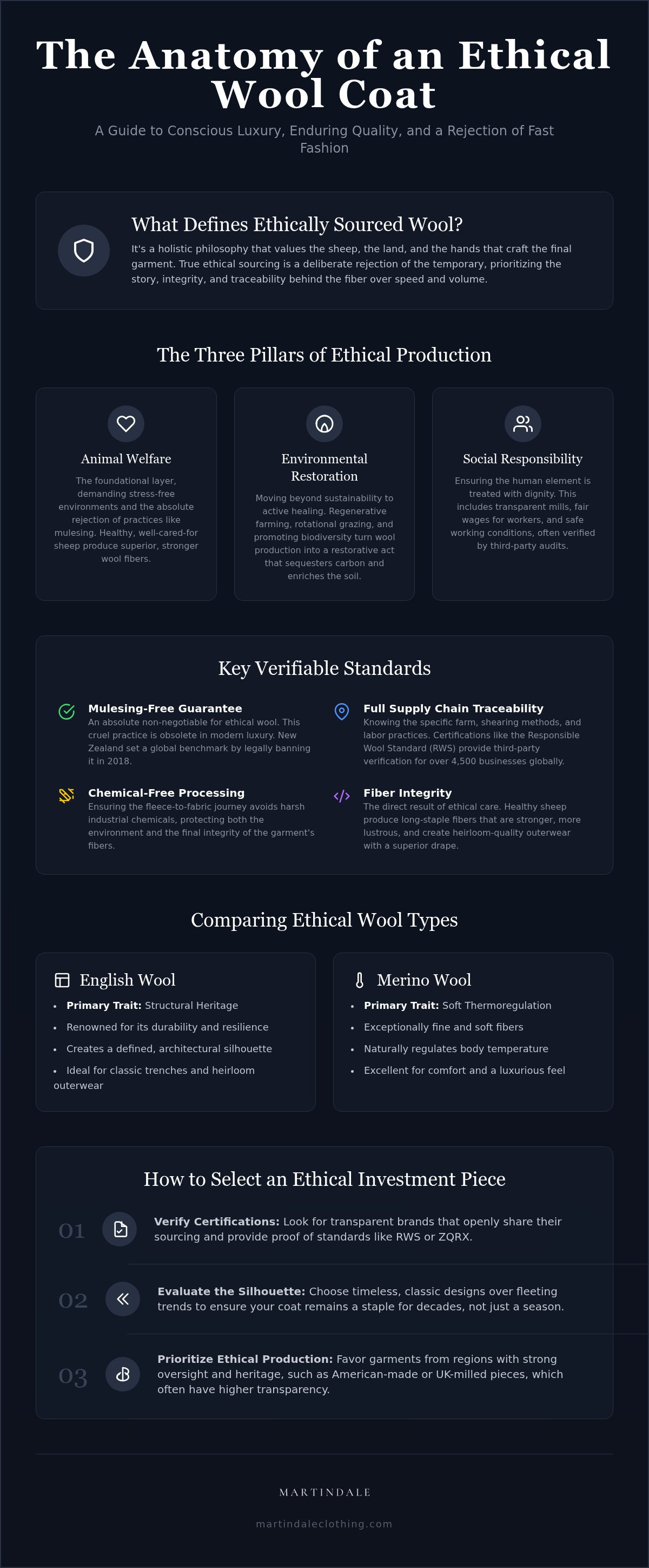
A primary pillar of this standard is the absolute rejection of mulesing. This practice has no place in modern luxury. New Zealand legally banned the practice in 2018, setting a benchmark for the global market. When you choose a coat from a brand that demands mulesing-free certification, you're supporting a higher standard of animal welfare that directly impacts the fiber's physical integrity. Stress-free sheep produce wool with fewer breakages and better consistency. This results in a superior drape and a more resilient finish for investment pieces like the Eleanor Wool Coat in Noir.
The Core Standards of Ethical Sourcing
Transparency is the only effective antidote to greenwashing. The Responsible Wool Standard (RWS) currently serves as a vital framework for global transparency, though it's set to be amalgamated into the new Material Matters Standard by April 2026. These certifications ensure that every stage of the supply chain is verified by third parties. Traceability means knowing the specific farm, the shearing methods used, and the labor practices involved. It's about moving from an opaque transaction to an intentional partnership between the consumer and the creator.
Why Ethics and Quality are Inseparable
Physical quality is a direct consequence of biological care. Healthy sheep grazing on well-managed pastures produce long-staple fibers that are naturally stronger and more lustrous. This physical strength allows for the creation of heirloom-quality outerwear like the Maggie Glen Plaid Trench in English Wool. Ethical land management, particularly regenerative farming, ensures the land remains vibrant for generations. It prevents overgrazing and promotes carbon sequestration, turning wool production into a restorative act. This is the essence of the "Investment Piece" mindset. By choosing ethically sourced wool for women's coats, you aren't just buying a garment; you're securing a legacy of permanence that resists the frantic cycles of disposable fashion.
The Pillars of Ethical Wool Production: Beyond Animal Welfare
Ethical integrity is an architectural feat. It requires more than just the absence of harm; it demands the presence of restoration. While animal welfare is the foundational layer, the true connoisseur looks toward the ecological and social systems that sustain the fiber. Choosing ethically sourced wool for women's coats means endorsing a cycle where every participant, from the soil to the seamstress, is treated with dignity. This multi-dimensional approach ensures that your garment is as beautiful in its production as it is in its final form.
Regenerative Farming and Soil Health
Industrial agriculture often views land as a resource to be extracted. Regenerative farming views it as a living system to be healed. Through techniques like rotational grazing, sheep become active participants in carbon sequestration and biodiversity restoration. The ZQRX standard represents a significant shift in this direction, moving beyond simple sustainability toward restorative environmental practices. By promoting healthy root systems and natural fertilization, these farms ensure that wool remains a renewable, biodegradable alternative to the synthetic fibers currently saturating the market. It's a choice for permanence over pollution.
- Rotational grazing prevents overgrazing and allows native flora to thrive.
- Healthy soil acts as a powerful carbon sink, mitigating the environmental footprint of textile production.
- Biodiversity in wool-producing regions protects local wildlife and water cycles.
Mill Transparency and Fair Wages
The journey from fleece to fabric is where the human element of ethics becomes visible. High-end textile mills, particularly those with deep heritage in the UK and the USA, operate with a level of transparency that fast-fashion processing simply cannot match. This transparency is often codified by the Responsible Wool Standard, which currently counts over 4,500 certified businesses globally. These standards ensure that every stage of production is audited for safety and fairness. Choosing heritage mills helps you avoid the hidden human cost of unregulated processing centers.
Meticulous oversight in these premium mills also impacts the physical quality of the cloth. When a mill uses chemical-free processing and advanced water conservation methods, the resulting fabric maintains its natural oils and structural strength. This integrity is what allows a piece like the Patrice Wool Coat in Chestnut to maintain its drape and warmth for decades. It's a partnership between nature and craftsmanship, resulting in a product that feels as good on the conscience as it does on the shoulders. By prioritizing fair labor and environmental stewardship at the mill level, we reject the transience of modern retail in favor of a more considered, ethical legacy.
English Wool and Merino: Comparing Ethics and Performance
Choosing between English wool and Merino is a decision between two distinct philosophies of warmth. While the fashion industry often treats wool as a generic commodity, the connoisseur understands that fiber origin dictates both the silhouette and the ethical footprint. When seeking ethically sourced wool for women's coats, the distinction between a structured heritage piece and a soft, thermoregulating layer is paramount. It's a choice between architectural strength and sensory softness.
English wool is the hallmark of durability. It possesses a crispness and density that allows for the sharp lines seen in the Maggie Glen Plaid Trench in English Wool. This fiber is inherently rugged, designed by nature to withstand the damp, wind-swept climates of the British Isles. From an ethical perspective, historic British textile regions offer a transparent lineage of production. Research into sustainable wool production highlights how these traditional methods preserve both the land and the quality of the clip, ensuring the material remains a renewable staple of a responsible wardrobe.
Merino wool offers a different experience, prized for its exceptional fineness and ability to regulate body temperature. It's ideal for lighter outerwear or transitional layers that require a fluid drape. However, the Merino market has seen significant volatility. In March 2026, the Australian Eastern Market Indicator reached 1,767 cents/kg, driven by tight supply and high global demand. For the ethical consumer, this volatility underscores the importance of certifications like ZQ Merino. These standards ensure that even as prices rise, the requirements for animal welfare and land management remain steadfast. The choice between these fibers often comes down to the intended lifecycle of the garment. English wool prioritizes structural permanence, while Merino prioritizes immediate comfort.
The Durability of English Wool
Structured trenches and tailored silhouettes require a fiber with memory. English wool provides this stability naturally. Its heavier micron count creates a natural barrier against the elements, offering wind-breaking properties that finer wools cannot match. By investing in this material, you're choosing a garment that maintains its shape year after year, resisting the sagging or pilling common in mass-produced alternatives. It's a fiber that breaks in rather than wearing out.
The Versatility of Premium Blends
Transitional seasons often call for the nuanced performance of fiber combinations. Mixing ethically sourced wool for women's coats with linen or silk can create a fabric that breathes while maintaining a sophisticated weight. The Josephine Linen Blazer in Slate exemplifies this balance, offering the crispness of linen with the resilience of wool. Maintaining an ethical profile in a blend requires verifying each component. A commitment to slow fashion means ensuring that the silk or linen meets the same rigorous labor and environmental standards as the wool itself, creating a piece that is as principled as it is versatile.
Investing in Permanence: How to Select an Ethical Wool Coat
To select a coat is to select a companion for the next decade. It's a deliberate move away from the frantic pace of modern retail toward a more intentional way of dressing. When you prioritize ethically sourced wool for women's coats, you're choosing a garment that possesses both moral and physical weight. This selection process requires a shift in perspective. You must look past the immediate aesthetic and evaluate the structural integrity and the origin of the craft. A truly premium coat is an architectural achievement designed to withstand both the elements and the shifting winds of trend.
The manufacturing origin is your most reliable indicator of ethical oversight. Domestic production, specifically garments designed and sewn in America, offers a level of transparency that overseas mass production cannot replicate. When a brand maintains a close relationship with its sewing rooms, every stitch is accounted for. This proximity ensures that fair labor practices are a lived reality rather than a marketing claim. It's the difference between a product that is merely "distributed" and one that is "crafted."
The Anatomy of a Quality Coat
A superior coat reveals its quality in the details you don't always see at first glance. Examine the reinforcement of the seams and the weight of the lining. High-end materials like mulberry satin, found in the Amelia Bomber Jacket, provide a friction-free layer that protects the wool from the inside out. Structure is equally vital. A tailored silhouette should feel stable on the shoulders and maintain its line even when in motion. This intentionality is often reflected in naming conventions. When a piece is personified, like the Patrice or the Eleanor, it signals that the design is a distinct identity rather than a generic SKU in a fast-fashion cycle.
The financial logic of this investment rests on the concept of cost-per-wear. While an upfront investment of over $1,000 may seem significant, its value compounds over time. A cheap, synthetic alternative may last a single season before losing its shape or pilling beyond repair. In contrast, a coat made from ethically sourced wool for women's coats retains its elegance for decades. When the cost is spread across hundreds of cold-weather days, the investment piece becomes the more economical choice.
Caring for Your Investment
Maintenance is a form of respect for the craft. Ethical wool is a resilient, natural fiber that requires less frequent cleaning than synthetic blends. Often, a simple brushing with a soft-bristle garment brush and a night of airing out is enough to refresh the piece. Proper storage on a wide, contoured hanger prevents the weight of the wool from distorting the shoulders. Over time, a trusted professional tailor can make minor adjustments to ensure the fit remains perfect as your style evolves. This partnership between the owner and the garment is what transforms a simple purchase into a lasting legacy. To begin your own journey toward a more considered wardrobe, explore our collection of American-made wool coats.
Martindale: Redefining American Luxury Through Ethical Craftsmanship
At Martindale, we believe the story of a garment is as significant as its silhouette. True luxury isn't found in the frantic pace of seasonal trends; it's found in the quiet authority of a piece built to last for decades. Every item in our collection is designed and sewn in America, a deliberate choice that allows for total transparency from the first sketch to the final stitch. By utilizing ethically sourced wool for women's coats, we ensure that the physical durability of our designs matches the moral integrity of their creation. This commitment positions Martindale as a steadfast alternative to the global fast-fashion crisis, offering a path toward a more considered and permanent wardrobe.
The Power of Domestic Production
Domestic manufacturing is the ultimate safeguard for ethical labor. When production happens in local American ateliers, oversight is immediate and absolute. We reject the opaque supply chains that often hide the human cost of mass-market outerwear. By maintaining a close relationship with our sewing rooms, we guarantee safe working conditions and fair wages for the skilled artisans who bring our designs to life. This localized approach also significantly reduces the carbon footprint associated with global shipping and logistics. It's a rejection of transience in favor of supporting the heritage of American garment workers, ensuring that the craft of high-end tailoring remains vibrant on domestic soil.
The Martindale Collection: A Study in Wool
Our collection is a curated exploration of how ethically sourced wool for women's coats can define a lifestyle of mindfulness. Each piece is personified, possessing a distinct identity that resists the anonymity of industrial production. The Patrice Wool Coat in Chestnut is a masterclass in ethical tailoring, offering a structured warmth that feels both premium and grounded. For those seeking the essential foundation of a capsule wardrobe, the Eleanor Wool Coat in Noir provides a timeless black silhouette designed to remain relevant for a lifetime. These aren't just purchases; they're investments in a long-term partnership between the wearer and the object.
- The Maggie Glen Plaid Trench in English Wool: This piece merges the rugged heritage of British textiles with the precision of American design, offering a wind-breaking layer that breaks in beautifully over time.
- The Patrice Wool Coat in Chestnut: A warm, sophisticated silhouette that exemplifies our commitment to slow fashion principles.
- The Eleanor Wool Coat in Noir: An architectural achievement in Noir wool, providing a stable and enduring aesthetic for any winter wardrobe.
Choosing Martindale is a declaration of values. It's a choice to prioritize substance over fleeting popularity and integrity over profit. As the textile industry shifts toward more unified sustainability standards by April 2026, we remain a leader in this cultural shift. We invite you to move beyond the temporary and embrace a wardrobe centered on legacy, heritage, and the enduring warmth of ethically sourced materials.
Defining a Legacy of Intentional Style
A winter wardrobe should be a curated collection of stories, not a graveyard of discarded trends. We've explored how the intersection of regenerative farming, transparent labor, and architectural design creates a garment that transcends the seasonal cycle. By prioritizing ethically sourced wool for women's coats, you secure a piece that honors both the artisan and the environment. True luxury is found in this stability, where the physical durability of English wool meets the moral clarity of domestic production. It's an investment in permanence that pays dividends in both warmth and conscience.
Every Martindale garment is designed and sewn in America, utilizing premium materials like English wool and mulberry satin to ensure a lifelong partnership with the wearer. We invite you to reject the frantic pace of the global fashion crisis and embrace a more considered aesthetic. With free shipping on all domestic orders, it's never been more seamless to align your wardrobe with your values. Explore the Martindale Collection of Ethically Made Wool Coats and discover the quiet authority of a coat built for a lifetime. Your journey toward a more mindful, sophisticated future begins with a single, principled choice.
Frequently Asked Questions
What makes wool 'ethically sourced' compared to standard wool?
Ethical sourcing encompasses a holistic commitment to animal welfare, land restoration, and fair labor practices. While standard wool often prioritizes industrial volume and speed, ethical wool is defined by total transparency and the absence of harmful practices like mulesing. It represents a deliberate move toward restorative farming and a rejection of the anonymous mass production cycle. This approach ensures the fiber is as principled as it is physically resilient.
Is ethically sourced wool more expensive?
While the initial cost of ethical wool is higher, its true value is realized through superior durability and a lower cost-per-wear. The price reflects the investment required for responsible land management and fair wages for skilled artisans. In the long term, an investment in a premium coat is more economical than the repeated replacement of flimsy, synthetic alternatives that fail after a single season of wear.
How can I tell if a brand is truly using ethical wool?
Look for third-party certifications and total transparency regarding the manufacturing origin of the garment. Reputable brands will openly discuss their supply chain and the specific farms or mills they partner with. Using ethically sourced wool for women's coats is a point of pride that a principled brand will verify through standards like the Responsible Wool Standard (RWS) or ZQ Merino to ensure accountability.
What is the Responsible Wool Standard (RWS)?
The Responsible Wool Standard is a global certification ensuring sheep are treated with respect and land is managed responsibly. As of March 2026, over 4,500 businesses are certified to the RWS. It provides a verified chain of custody from the farm to the final coat. Note that the RWS is scheduled to be amalgamated into the multi-fiber Material Matters Standard by April 2026 to further unify sustainability efforts.
Why is American-made outerwear considered more ethical?
Domestic production allows for direct oversight and absolute transparency in labor practices that overseas manufacturing cannot match. When a coat is designed and sewn in America, it eliminates the opaque supply chains typical of industrial mass production. This proximity ensures that every stitch is accounted for and that the artisans involved are treated with the dignity and fairness they deserve, fostering a sustainable local heritage.
Does ethical wool require special care compared to synthetic coats?
Ethical wool is a resilient natural fiber that actually requires less frequent cleaning than synthetic blends. It possesses natural odor-resistant and self-refreshing properties that keep it pristine with minimal intervention. Simple maintenance, such as brushing with a soft-bristle garment brush and proper storage on a wide, contoured hanger, is usually sufficient to maintain the garment's structural integrity and sophisticated appearance for many decades.
What is 'mulesing' and why is it banned in ethical fashion?
Mulesing is an invasive procedure used to prevent flystrike, but it's widely considered inhumane and has no place in modern luxury. New Zealand legally banned the practice in 2018, setting a standard for global ethical sourcing. Principled brands favor humane management and selective breeding instead. This care results in healthier sheep and superior wool fibers, as stress-free animals produce wool with significantly fewer breakages and a more consistent drape.
Can an ethical wool coat really last for decades?
Yes, a coat made from high-quality, ethically sourced wool for women's coats is an architectural achievement designed for permanence. When combined with traditional craftsmanship and reinforced construction, these garments maintain their structure and elegance for a lifetime. This longevity stands in direct opposition to the transience of fast fashion, turning a simple purchase into a lasting legacy and a cornerstone of a sustainable, curated wardrobe.


