

If a garment possesses the strength to outlive the person who first wore it, is it still merely an item of clothing, or has it become a legacy? You've likely felt the exhaustion of modern retail, where "sustainable" labels often mask a cycle of planned obsolescence and fleeting trends. It's natural to feel skeptical of industry buzzwords and wonder if any material can truly withstand the test of time. This guide explores the foundational question: is linen a sustainable fabric? We'll move beyond the shallow promises of fast fashion to reveal why this ancient flax fiber remains the gold standard for a conscious, enduring wardrobe.
You'll learn how to distinguish between temporary fast-fashion iterations and high-quality investments like the Josephine Linen Blazer, which is designed for decades of wear. We'll examine the environmental integrity of the flax plant, the moral value of domestic craftsmanship, and the specific markers of quality that ensure your garment ages with grace rather than discarding its character after a few washes. Discover how to build a collection rooted in permanence and ethical discernment.
The Ecology of Flax: Why Linen is a Sustainable Benchmark
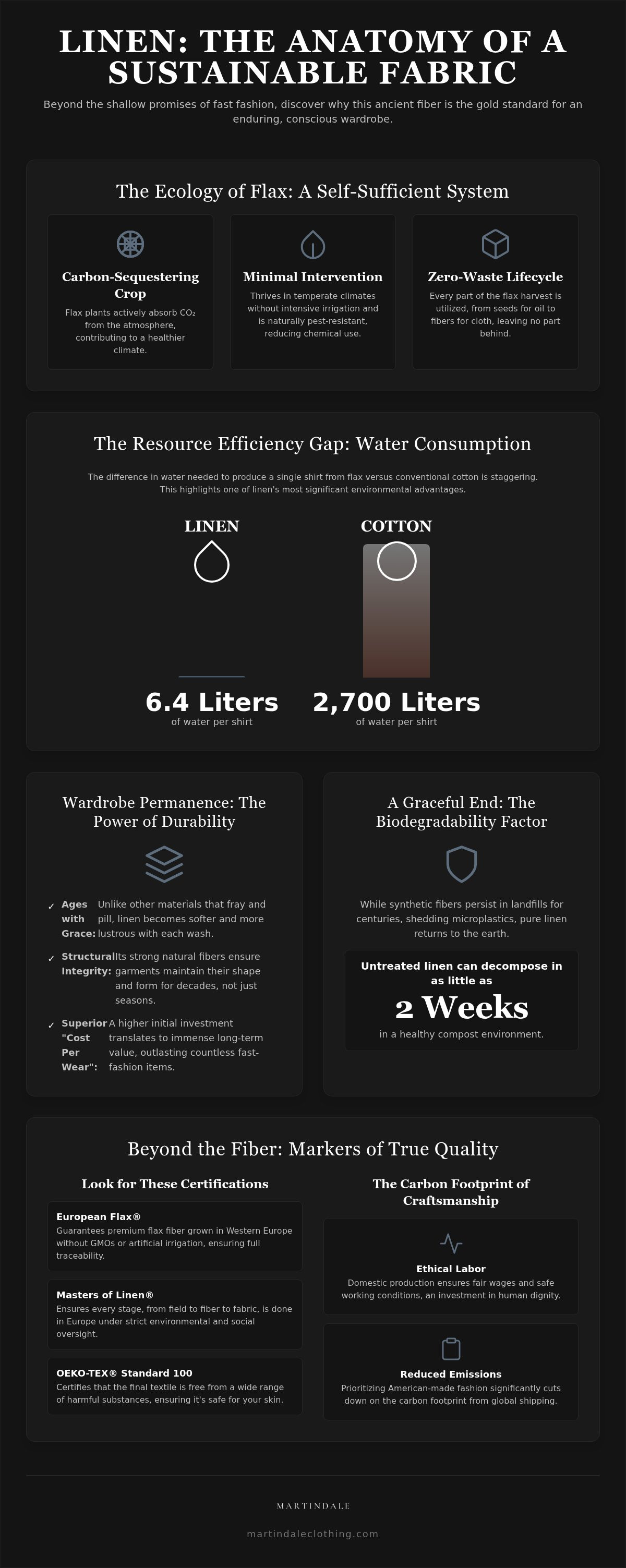
Understanding why is linen a sustainable fabric requires looking past the finished garment to the resilient flax plant itself. Flax is a carbon-sequestering crop that thrives in temperate climates without the need for intensive irrigation or artificial life support. It's a plant defined by its self-sufficiency. The Ecology of Flax demonstrates a rare industrial harmony; every portion of the harvest is utilized, from the seeds used for linseed oil to the fibers woven into fine cloth. This zero-waste lifecycle stands as a quiet, authoritative alternative to the extractive norms of modern textile production.
Linen vs. Cotton: The Resource Efficiency Gap
The distinction between flax and conventional cotton is one of sheer survival versus excess. Growing enough flax for a single shirt requires roughly 6.4 liters of water, a figure that pales in comparison to the 2,700 liters demanded by a cotton equivalent. Because flax naturally resists pests, it doesn't require the chemical interventions that poison local soil and water tables. Choosing linen is an intentional move away from resource-heavy crops toward a more stable, heritage-focused method of dressing.
The Biodegradability Factor
Linen's journey ends as gracefully as it begins. While synthetic fibers shed microplastics and endure in landfills for centuries, pure linen is naturally biodegradable. Untreated fibers can decompose in as little as two weeks in a healthy compost environment. This circularity is a core tenet of the Josephine Linen Blazer, where the focus remains on material integrity rather than temporary trends. When we invest in pieces that use natural dyes and finishes, we honor a lifecycle that eventually returns to the earth without a trace of harm.
Beyond the Fiber: The Role of Origin and Ethical Production
True sustainability isn't a single data point; it's a holistic metric that weighs the carbon footprint of transit against the moral integrity of the sewing room. While the biological properties of flax are impressive, the answer to whether is linen a sustainable fabric depends heavily on its origin. European-grown flax remains the global benchmark for quality. Certifications like Masters of Linen ensure that every stage of production, from field to fiber, adheres to strict environmental and social oversight. This contrasts sharply with "fast linen," where mass production often sacrifices ethical labor and chemical safety to achieve an enticingly low price point.
The "Organic" Linen Debate
Many consumers seek "organic" labels, yet flax is naturally hardy and often grown without synthetic fertilizers by default. Instead of chasing a single label, look for European Flax® and OEKO-TEX® Standard 100 certifications. These designations ensure the material is non-GMO and free from harmful substances. It's a commitment to purity that transcends marketing buzzwords, focusing instead on the physical and chemical safety of the textile.
The Carbon Footprint of Craftsmanship
A garment's impact is tied to the miles it travels. By prioritizing American-made women’s fashion, we reduce the emissions inherent in global shipping cycles. Domestic production isn't just about logistics; it's a moral imperative. It ensures fair wages and safe conditions, turning a simple purchase into an investment in human dignity. When you choose a piece like the Josephine Linen Blazer from our curated collection, you're supporting a transparent, low-impact supply chain that values the artisan as much as the wearer. This intentionality is what truly defines whether is linen a sustainable fabric in the modern world.
Wardrobe Permanence: The Sustainability of Durability
A fabric is only as sustainable as the garment is durable. A linen piece that remains in your rotation for thirty years is vastly superior to a recycled synthetic that loses its shape after two. This inherent longevity is the primary reason why is linen a sustainable fabric for those building a legacy wardrobe. While other materials fray and pill, linen possesses a rare structural integrity. It ages with a quiet grace, becoming softer and more lustrous with every wash and wear. It doesn't just survive; it evolves.
Many hesitant buyers point to the characteristic wrinkle as a deterrent. However, in the world of high-end tailoring, the natural drape of unblended flax is a hallmark of quality. These creases signify a material that's free from the stiffening chemicals and plastic blends found in fast fashion. It's a texture that speaks of authenticity and ease. When we discuss wardrobe permanence, we're talking about garments that embrace their natural state while maintaining their form for decades.
The Investment Mindset: Cost Per Wear
Choosing a premium linen piece requires a shift from a transactional mindset to an investment one. When you calculate the cost per wear over a decade of professional and social use, the value becomes clear. Slow fashion designs, such as the Josephine Linen Blazer, avoid the planned obsolescence of trend-driven silhouettes. They remain relevant as the seasons shift and styles fade, ensuring your investment retains its aesthetic and moral value.
Linen as a Multi-Season Essential
Linen's utility isn't confined to the height of summer. Its unique thermoregulation properties allow it to breathe during heatwaves while retaining body warmth during transitional months. A well-constructed blazer serves as a bridge between formal and casual environments, offering a sophisticated layer that adapts to your climate. You can explore our ethically crafted blazers to find a piece that offers this year-round versatility without compromising on your standards.
Selecting and Caring for Premium Linen Apparel
Discerning quality requires an eye for physical substance. High-quality linen is defined by its tactile weight and the density of its weave; a true heritage piece will never feel flimsy or transparent. When examining the fabric, you may notice "slubs," which are natural variations in the thickness of the flax fiber. These aren't defects. They're the fingerprint of an unadulterated material. Because pure linen remains fully biodegradable and free from microplastics, the answer to whether is linen a sustainable fabric is inextricably linked to the absence of synthetic blends.
The Josephine Linen Blazer serves as a masterclass in this philosophy. Ethically produced in the United States, it represents a commitment to stability over transience. Each piece is constructed with the understanding that a blazer should serve as a long-term partner to the wearer, aging alongside them rather than falling apart after a single season. This intentionality ensures that the garment's environmental impact is amortized over a lifetime of use.
How to Spot Quality Tailoring
Superior construction is visible in the details that fast fashion ignores. Look for finished seams and reinforced points of tension that support the fabric's natural movement. The Josephine Linen Blazer in Slate or Ink is a foundational investment piece for a women’s wardrobe, designed with an architectural precision that respects the fiber's integrity. These garments maintain their silhouette through years of wear because they're built on a foundation of traditional craftsmanship rather than temporary adhesives.
Caring for Your Heritage Pieces
Preserving a garment's identity requires a methodical approach to maintenance. While linen is famously resilient, its lifespan is extended through gentle care. Use cold water and mild detergents on a delicate cycle to preserve fiber strength; avoid the high heat of a dryer, which can cause brittle textures. For structured items like blazers, occasional professional cleaning can help maintain the sharp lines of the lapel. Store your pieces on wide, padded hangers to prevent structural damage, ensuring they remain a steadfast part of your collection for decades to come.
Cultivating a Wardrobe of Enduring Value
Choosing between the temporary and the permanent is a moral act. We've explored how the answer to whether is linen a sustainable fabric lies not just in the plant's low water consumption, but in the garment's ability to withstand the passage of time. By prioritizing premium natural fibers and timeless heritage design, you reject the waste of the modern trend cycle. True sustainability is found where ethical origin meets uncompromising quality. Pieces that are ethically sewn in America provide a transparent alternative to the opaque supply chains of global fast fashion. This intentionality transforms a simple purchase into a long-term partnership with your wardrobe. It's time to move beyond the disposable and embrace a style defined by stability and grace. Explore the Josephine Linen Blazer and invest in wardrobe permanence. Your journey toward a more considered lifestyle begins with a single, meaningful choice.
Frequently Asked Questions
Is linen more sustainable than organic cotton?
People often ask, is linen a sustainable fabric compared to organic cotton? The answer lies in its minimal reliance on external inputs. While organic cotton eliminates synthetic pesticides, it still requires significant irrigation. Flax is naturally hardy and thrives in temperate climates primarily on rainwater. This makes it a more resource-efficient choice. Choosing linen is a deliberate move toward a more responsible relationship with our natural resources.
Why is high-quality linen so expensive?
The price reflects a commitment to craftsmanship and ethical integrity. High-quality linen involves labor-intensive harvesting and weaving processes that can't be rushed. When a garment is sewn in America, like the Josephine Linen Blazer, the cost includes fair wages and safe working conditions. You're investing in a heritage piece designed for decades of wear rather than a disposable item destined for a landfill.
Does linen require a lot of water to produce?
When considering is linen a sustainable fabric, water usage is a critical factor. Flax is remarkably un-demanding. It requires roughly 6.4 liters of water to produce a single shirt, a figure that pales in comparison to the thousands of liters needed for cotton. It grows successfully in poor soil with minimal intervention, protecting local ecosystems from the strain of intensive industrial irrigation.
How long does a linen garment typically last?
A well-crafted linen garment can easily last thirty years or more. Unlike synthetic materials that fray or cotton that eventually thins, linen's structural integrity actually improves with age. It becomes softer and more lustrous with every wash. Proper maintenance ensures that your investment remains a foundational part of your wardrobe, serving as a quiet, enduring alternative to the cycle of fast fashion.
Is linen fabric biodegradable?
Pure linen is entirely biodegradable. Because it's a natural fiber derived from the flax plant, it can decompose in a healthy compost environment in approximately two weeks. It returns to the earth without shedding microplastics or toxic residues. This circular lifecycle is essential for those seeking to minimize their environmental footprint while maintaining a sophisticated and intentional personal style centered on permanent value.
What is the difference between European flax and other types of linen?
European flax represents the pinnacle of quality and environmental oversight. The temperate climate of Western Europe is ideal for growing long, strong fibers that resist breakage. Certifications like European Flax® ensure the crop is non-GMO and produced using zero-waste methods. This geographic heritage guarantees a level of physical and moral integrity that mass-produced linen from other regions often fails to match.


