


True luxury isn't found in the relentless cycle of seasonal trends but in the quiet strength of an american made women's blazer built to outlast them. You've likely felt the frustration of a mass-market jacket that loses its shape after a few wears or the deep unease of a label that obscures its human cost. It's difficult to feel truly confident when your professional wardrobe feels disposable, poorly constructed, or ethically compromised. You deserve a piece that reflects both your aesthetic discernment and your moral principles.
This study explores why domestic tailoring represents the definitive intersection of integrity and structural permanence. We'll examine the rigorous standards of American manufacturing, the movement toward slow fashion, and how a single, well-considered piece like the Josephine Linen Blazer can simplify your morning routine while anchoring your style for decades. Discover how investing in garments designed and sewn in America allows you to reject the temporary in favor of a lasting, sophisticated legacy.
Defining the Ethically Produced Women's Blazer
An american made women's blazer represents a principled departure from the disposable nature of modern fashion. In 2026, ethical production is defined by a holistic commitment to the hands that craft the garment. While many brands focus solely on organic materials, true integrity requires a focus on labor practices. This distinction is vital; a garment is only as sustainable as the conditions in which it was created. Domestic manufacturing ensures that workers are protected by rigorous standards, providing a level of transparency that global supply chains often lack.
The Pillars of Ethical Tailoring
Ethical tailoring begins with fair wages and safe environments. These are the baselines for genuine luxury. Domestic production allows for small-batch manufacturing, which minimizes the environmental impact of textile waste. Unlike mass-market models that prioritize volume, this approach values the long-term relationship between the maker and the wearer. It's a choice for quality over sheer volume.
A blazer demands significantly more technical expertise than standard knitwear. It requires structured shoulders, precise lapels, and internal reinforcements that maintain its silhouette. Throughout the history of the blazer, this item has served as a cornerstone of the professional wardrobe. This complexity means that mass-produced versions often rely on shortcuts that compromise the garment’s life span, whereas a considered garment offers structural stability.
From Fast Fashion to Wardrobe Permanence
Modern retail often relies on planned obsolescence. Cheap blazers use inferior interlinings that bubble or lose shape after minimal wear. Conversely, ethical production naturally leads to durability. When you select an american made women's blazer, such as the Josephine Linen Blazer, you're choosing a piece designed for decades of use. Transparency in how these pieces are constructed builds a foundation of trust. You can view these intentional designs in our online shop.
The Significance of the 'Made in USA' Label in 2026
The "Made in USA" label represents a definitive standard of quality that transcends simple geography. In 2026, the Federal Trade Commission enforces strict Made in USA label requirements to ensure that any garment bearing this mark is "all or virtually all" produced domestically. This legal rigor provides a foundation of trust for the modern woman seeking a high-quality american made women's blazer. It's a certification of origin that guarantees the garment hasn't been touched by the ambiguity of global middle-men.
Oversight is the primary advantage of domestic production. When a designer can physically step into the sewing room, they maintain absolute control over every stitch. This proximity prevents the structural failures common in offshore manufacturing. Choosing an american made women's blazer isn't just about supporting a local business; it's about securing a garment that has been scrutinized at every stage of its creation. It ensures that the internal architecture of the piece is as refined as its exterior.
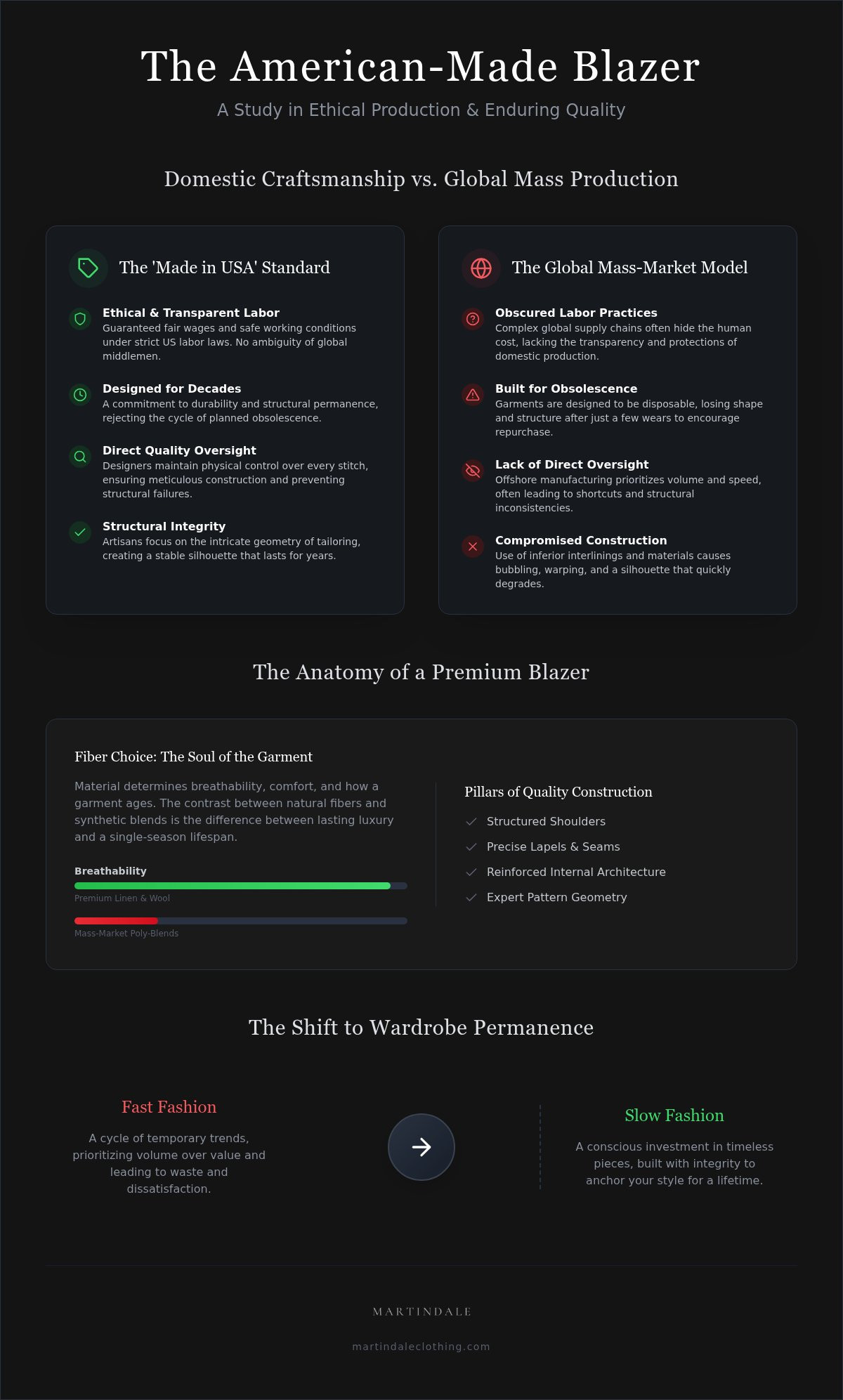
Domestic Craftsmanship vs. Global Mass Production
Precision is the hallmark of American sewing rooms. While global mass production prioritizes speed, domestic artisans focus on the intricate geometry of tailored patterns. A blazer "sewn in the USA" possesses a higher standard of structural integrity because it's built with an understanding of how fabric moves and ages. It's the difference between a temporary silhouette and one that remains stable for years. This focus on detail creates a garment that feels personal rather than processed.
A Commitment to Domestic Heritage
Maintaining a national production footprint is a deliberate choice to honor a legacy of craftsmanship and support the local economies that sustain it. With over 10,000 apparel manufacturers operating in the United States in 2026, this commitment ensures that specialized skills remain vibrant within our communities. You can see this dedication to heritage in the Josephine Linen Blazer, available alongside our other timeless pieces in the Martindale shop.
American manufacturing preserves traditional tailoring techniques by prioritizing human expertise and time-honored construction methods over the frantic shortcuts of global mass production.
Materiality and Construction: The Anatomy of a Premium Blazer
Fiber choice determines a garment's soul. While mass-market retailers often favor poly-wool blends for cost efficiency, these materials sacrifice the breathability and luxury found in natural fibers. An american made women's blazer relies on the inherent properties of premium wool and linen to provide lasting comfort. These materials don't just sit on the body; they breathe with it. Choosing natural fibers ensures your investment ages with grace rather than degrading after a single season of wear.
The Versatility of Premium Linen
Premium linen offers a unique intersection of structure and ease. Derived from high-quality flax fibers, it provides a natural breathability that synthetic alternatives can't replicate. The Josephine Linen Blazer serves as a case study in summer professional sophistication. Its "lived-in" elegance allows the wearer to remain composed in high-heat environments without sacrificing a tailored silhouette. You can explore the Martindale collection for timeless linen essentials that anchor a seasonal wardrobe.
Structural Integrity and Lining
Internal architecture defines the lifespan of a jacket. Most mass-market blazers use fused interlinings that eventually bubble and peel. A premium garment utilizes reinforced seams and high-quality linings to maintain its drape over decades. This attention to detail ensures the garment adheres to the rigorous expectations of the FTC's 'Made in USA' Standard, reflecting a commitment to both physical and moral integrity. Meticulous stitching serves as a quiet indicator of a slow-fashion philosophy that rejects the temporary.
Structural permanence is the result of intentional design and expert execution. When you choose a garment with reinforced construction, you're simplifying your future professional dressing. Secure your investment in wardrobe permanence by browsing our current selection at the Martindale shop.
Curating a Legacy Wardrobe with Ethical Investment Pieces
Investing in an american made women's blazer is a transition from the frantic pace of fast fashion to a philosophy of wardrobe permanence. While a mass-market jacket might satisfy a fleeting trend, a premium piece is designed to serve as a decade-long companion. This shift in perspective is both a financial and a moral decision. It's an intentional choice to favor substance over the temporary allure of the new.
The "Cost Per Wear" calculation reveals the true economy of high-end tailoring. A garment that retains its structural integrity through hundreds of wears is ultimately more affordable than a series of cheaper, disposable alternatives that fail after a single season. Beyond the financial logic, there's a profound psychological benefit in wearing clothing that aligns with your moral integrity. Knowing your blazer was produced under fair labor standards in American sewing rooms provides a quiet confidence that transcends simple aesthetics. It turns professional dressing into an act of mindfulness.
The Blazer as a Professional Anchor
A well-tailored piece transitions seamlessly from the boardroom to evening engagements. Whether paired with formal trousers or layered over a slip dress, its architectural precision remains constant. Its versatility simplifies the demands of a busy professional life. For those curious about how different silhouettes impact wardrobe permanence, consider our study on Bomber Jacket vs. Blazer.
Building a Sustainable Capsule Wardrobe
Versatility is the cornerstone of a minimalist, high-impact closet. By selecting an american made women's blazer in neutral tones like Ink or Slate, you create a foundation that supports a variety of looks. These colors offer a timeless appeal that bypasses the risk of feeling dated. You can curate your own legacy pieces and explore our full range of ethically produced garments by visiting the Martindale shop.
Investing in a Legacy of Integrity
Choosing an american made women's blazer is more than a wardrobe update. It's a deliberate rejection of the temporary and a commitment to domestic excellence. We have examined how the intersection of premium materials and the rigorous standards of American sewing rooms creates a garment intended for decades of wear. This isn't just about fashion; it's about the stability of your professional identity and the moral clarity of your choices. By prioritizing structural integrity over seasonal trends, you simplify your life while supporting a more responsible industry.
Every stitch in a Martindale piece represents a partnership between the maker and the wearer, built on transparency and pride. You don't have to settle for the ambiguity of global supply chains when a principled alternative exists. Take the first step toward a more intentional, permanent closet today. Shop the Ethically Crafted Josephine Linen Blazer and discover the quiet authority of a garment built to last. Your wardrobe deserves the strength of true craftsmanship.
Frequently Asked Questions
What exactly does 'ethically produced' mean in the context of women's fashion?
Ethical production refers to garments created under fair labor standards where workers receive living wages and operate in safe, regulated environments. For a brand like Martindale, it means maintaining a transparent supply chain that rejects the exploitation common in global mass production. It prioritizes human dignity and environmental responsibility over high-volume output. This approach ensures every piece is crafted with respect for both the maker and the final wearer.
Is a linen blazer professional enough for formal office environments?
A high-quality linen blazer is entirely professional when it features structured tailoring and refined finishing. Pieces like the Josephine Linen Blazer in Ink or Slate provide a crisp silhouette that holds its shape throughout the workday. While linen possesses a natural texture, its breathability and sophisticated drape make it an essential summer staple for the modern professional. It offers a polished look that remains comfortable in high-heat environments without sacrificing authority.
How can I tell if a blazer is truly made in the USA?
To verify if an american made women's blazer is authentic, look for clear labeling that adheres to the Federal Trade Commission’s "all or virtually all" standard. Truly domestic brands provide detailed information about their design and sewing processes within the United States. You should check for transparency regarding production methods and factory standards. Martindale ensures every garment is designed and sewn domestically, providing certainty that your clothing supports local craftsmanship.
Why is American-made clothing more expensive than imported alternatives?
Domestic manufacturing costs reflect the investment in fair wages, superior materials, and small-batch production. Unlike imported fast fashion that relies on low-cost labor and synthetic blends, American-made pieces utilize premium natural fibers like English wool or linen. These garments are built for decades of use rather than a single season. The higher initial cost is offset by the longevity and structural integrity of the piece, representing a long-term partnership with your wardrobe.
How do I care for a high-end linen blazer to ensure it lasts for years?
Proper care is essential for maintaining the permanence of high-end linen. You should opt for professional dry cleaning to preserve the internal structure and prevent shrinkage. Between wears, use a sturdy, shaped hanger to maintain the shoulder silhouette and allow the fabric to breathe. Minor wrinkles can be managed with a gentle steamer rather than a harsh iron. These simple steps ensure your blazer remains a foundational piece of your professional wardrobe for years.


