


There is a picture of me taken during freshman year of high school where I am wearing an icy blue top and khaki pants. To answer your question: yes, I always dreamt of being a middle-aged midwesterner when I grew up. In the photo, my hair is done. I have a little bit of make-up on. And yet, I look like every ounce of blood has been drained out of my body and all that is left is a pale, lifeless shell. As I flipped through the yearbook, I kept coming back to the photo, wondering exactly what went wrong.
Perhaps you have had a similar experience. Perhaps every now and then you are getting ready for the day, your make-up and hair done to perfection, only to put your outfit on and suddenly feel… flat, as if all the color has disappeared from your face. You knew something was wrong, even if you could not put your finger on it at the time. Even if you did not have a name for it at the time, you now understand the power of Color Theory.
Color is a powerful tool in your style arsenal. Use it correctly, and people will wonder how you always look so good. Shrug it off as marketing fluff, you will question why beige makes you look ten years older than your best friend.
Color theory, or color season, is innately personal, in that you have to discover your color season for yourself. Even within the same family there can be a huge amount of variation. My mom, sister, and I are each three separate color seasons. My sister is a True Summer; my mom is an Autumn, and I am a Deep Winter. If you line the three of us up, the family resemblance is evident, but throw burnt sienna on my sister or me and we transform into crypt keepers when compared to our autumnally-paletted mother.
“Personal style is simple; simple does not always mean easy.”
This is to say, do not try to copy your stylish co-worker’s color combinations and expect the same result. Chances are she is not your color season twin, and you will be even more frustrated for spending hard-earned money on clothing that never looks quite as good on you as it did on her. You will throw your hands up in the air and claim fashion is just not “for you”. Personal style is simple; simple does not always mean easy.
A great example of the power of well-executed Color Theory is from one of my all-time favorite millennial tv shows: Friends. I have watched the costume designer, Debra McGuire’s, behind-the-scenes interviews about how she chose to style each character; this is how nerdy I get about fashion. If you have a few extra hours to kill, it is a fascinating example of a professional at work, helping define her character’s through clothing and color.
In the early seasons, McGuire styled Monica, played by Courtney Cox, in deep jewel tones such as red, burgundy, deep blue, black, dark brown and green. The outfits that best enhance her natural beauty (not the most memorable; those are two different things) are the ones with deep, saturated colors or high contrast to emphasize the contrast of Cox’s blue eyes, dark hair, and fair skin - classic Winter features.
Now compare this to Jennifer Aniston’s character Rachel. All my Millenial girls (holla!) will remember her character’s iconic yellow, strapless mini dress from season five. She looked stunning. I realize this we are talking about one of the most beautiful women in the world. However, the dress was a perfect complement for her Summer color palette. Picture Cox wearing the same shade of yellow. Even though Cox is just as beautiful, the outfit does not pack the same punch. Rachel shined in mint green, soft yellows, smoky blues, and grays.
As the seasons wore on, the styling became more creative and the color palettes widened for the characters. However, the most iconic outfits, such as the yellow dress or the lipstick red engagement dress, are iconic because of how they flattered each actress’s unique beauty.
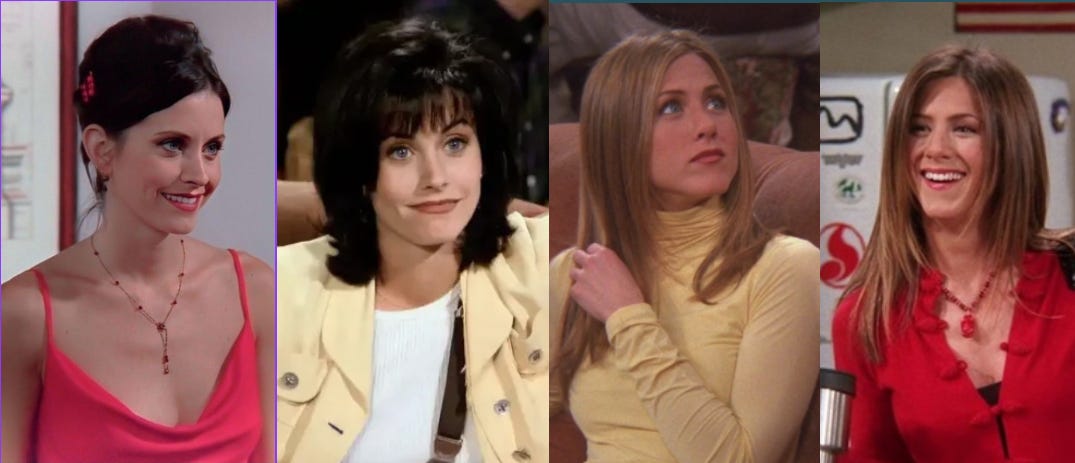
Below is an example of each character wearing butter yellow (summer) and bright red (winter). Again. These are two beautiful women. They are going to look beautiful all the time. However, you can see how the bright red highlights the best of Courtney’s features, while the yellow flattens out the lovely contrast in her coloring. On Aniston, the two colors behave exactly opposite. This is Color Theory at work.
At this point, you should be convinced Color Theory is an important step in your Best Dressed journey.
What next?
Step One: Discover your color palette/color season.
The absolutely best way is to find a professional color analyst to perform an in-person analysis where they typically will drape you in different swatches and watch for which ones highlight your features. You should walk away with a swatch book full of colors that you can use while shopping for clothing and make-up. You will walk away more confident in how to use color to your best advantage. This is the most foolproof approach but also the most costly and time-consuming method.
The cheaper and least time-intensive option is to take an online quiz, some of which now include AI photo analysis to determine your season as accurately as possible. These will not be as exact or personalized as an in-person analysis, but they can give you a good direction to move in.
Here are a few options:
Step Two: Stop buying colors that do not work for you.
I realize this sounds self-evident. As I said before, simple does not always equate to easy. If you are anything like me, one day, you will come across a dress or blouse or jacket that is perfect in every single way other than the color. And suddenly, you will find yourself standing in the shop convincing yourself if you just find the right lipstick, or only wear it when you’re ovulating, or finally get that tan you have always wanted, it will work. If a decade of Color Theory has taught me anything, it is that a leopard cannot change its’ spots, and I cannot wear cream, no matter how hard I try.
Step Three: Clean out your closet, slowly.
After I finally discovered my color palette, I went directly to my closet and immediately purged every item that was under-saturated or overly warm. I ended up with too many black and white leftovers, and very little clothing. It took me years to build my wardrobe back up. Just because we now understand Color Theory does not mean we need to immediately throw out half our closets.
Go through each item slowly. Start with the items you have never liked wearing and get rid of those first. Next, start adding in a few staple pieces in the right colors for you. Do not be afraid to get rid of expensive pieces that are the wrong color for you. Just like a bad boyfriend, no amount of money will make them right for you. Giving it up now will give the item a longer life with someone else who is perhaps searching for this exact piece.
Step Four: Be kind to yourself.
In the beginning, I was draconian in my application of Color Theory. If something didn’t fit exactly into my color wheel, I didn’t buy it. Ten years later, I allow myself to fudge the lines a bit. This summer, I purchased a pair of linen pants in a bright olive green. Although it is not my best color, it is still one of my favorites and wearing it on my bottom half ensures it is as far away from my face as possible to lessen its potency. I have also found a little bit of a tan can extend my color palette a little further into Autumn than is strictly correct for my deep winter hair, eye, and skin tone.
These days, I can look back at that icy-blue yearbook photo with a bit more compassion. I wasn’t unintentionally trying out to be the Bride of Dracula. I misunderstood how Color Theory impacts personal style.
As it turns out, many style problems are not nearly as complicated as we make them.
Color Theory will not solve every wardrobe dilemma. It will not make us look twenty years younger, transform us into French women, or suddenly give us Jennifer Aniston’s hair. What it can do is make getting dressed easier, more intentional, and a whole lot more flattering.
And in a world that seems determined to make everything more complicated, especially women’s innate beauty, I find it refreshingly simple.
Until next time,
Elise


