


That $150 polyester coat hanging in your closet might actually be the most expensive garment you own. While the initial price feels like a victory, the reality of a piece that pills after three weeks or loses its structure before the first frost is a hidden tax on your wardrobe. Most women have felt the frustration of watching a seasonal bargain crumble, coupled with a quiet guilt over its environmental impact. It's a cycle of transience that rewards the industry but leaves the wearer wanting. This guide will help you escape that loop by teaching you how to calculate the true cost per wear women's coat value.
You'll discover why choosing a premium, American-made investment is a more intentional and economical choice over a decade than the frantic pace of fast fashion. We'll explore the mathematical justification for wardrobe permanence, showing how high-density wool and traditional craftsmanship create a piece that looks as striking in year ten as it did on day one. By shifting your perspective from a fleeting transaction to a long-term partnership with your clothing, you can build a legacy of style rooted in ethical integrity and quiet authority.
Defining Cost Per Wear (CPW) for the Discerning Wardrobe
Sticker prices often lie. They suggest a value that doesn't account for the inevitable decay of disposable fashion. For the discerning woman, the true metric of value is the cost per wear women's coat calculation. This methodology reframes a purchase as a partnership. Instead of a fleeting transaction, you're investing in a decade of reliability. The "100-Wears Rule" serves as a baseline; if a garment cannot survive a hundred outings, it doesn't belong in a curated wardrobe. This shift in perspective moves us away from the frantic cycle of replacement and toward a philosophy of wardrobe permanence.
The Formula for Wardrobe Longevity
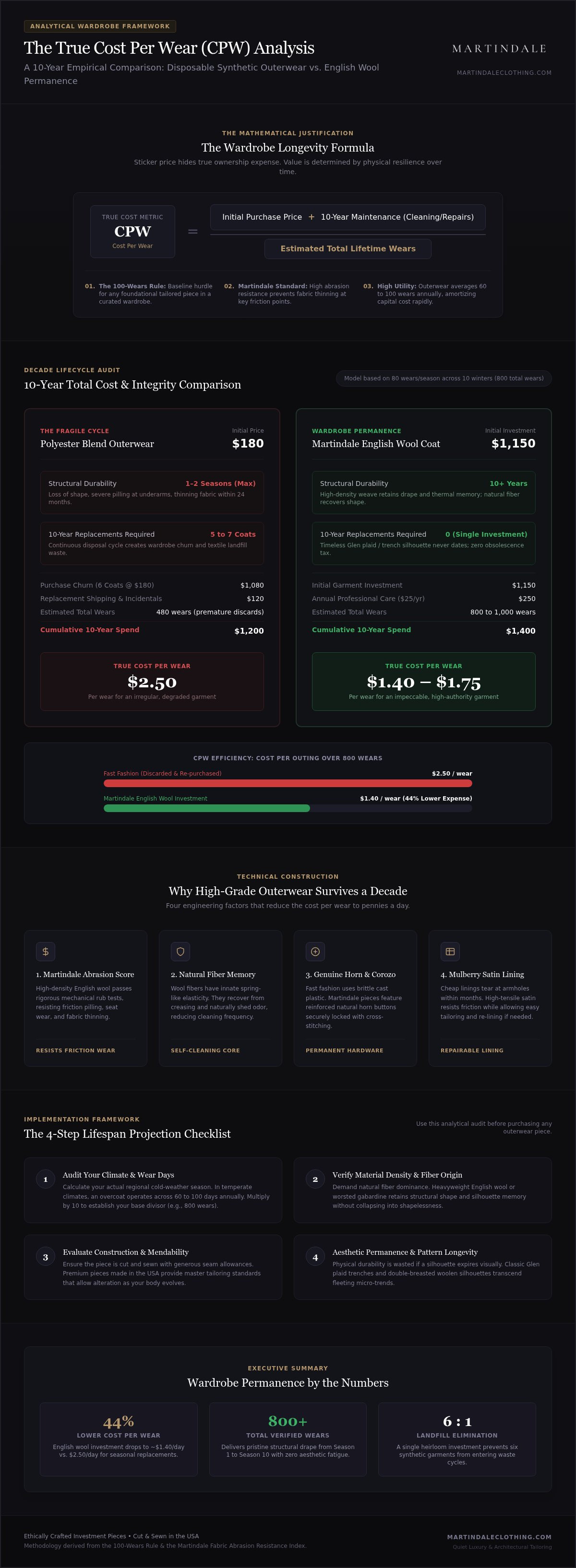
To find the real value, use the equation: (Purchase Price + Maintenance) / Estimated Number of Wears. Maintenance is vital. High-quality materials like English wool require professional care, but their durability is scientifically verifiable. Fabrics that score high on the Martindale abrasion test resist pilling and thinning over time. This technical resilience ensures your initial investment doesn't vanish after a single season of friction. When you factor in the cost of dry cleaning once per year, the lifetime value of a well-constructed piece remains far superior to a synthetic alternative that falls apart by February.
Outerwear: The High-Utility Investment
A coat is your most visible and frequently utilized layer. Unlike an evening gown worn once for a specific occasion, a piece like the Patrice Wool Coat might be worn 60 to 80 days annually. Over ten years, that equates to 800 wears. A premium coat's CPW often drops to a negligible amount per day. Contrast this with a cheap alternative that requires replacement every winter. The "bargain" remains perpetually expensive because its lifespan is measured in months, not decades. Investing in quality is a rejection of the temporary and a commitment to enduring style.
The Math of Permanence: Why Quality Fabric Lowers CPW
True value isn't found in a bargain; it's engineered into the fiber. When calculating the cost per wear women's coat, the material's physical resistance to time is the most significant variable. Synthetic blends, often marketed as affordable, carry a hidden tax. These polyester fibers lack the structural memory of natural wool. Within 24 months, they often pill, lose their silhouette, and require replacement. In contrast, English wool is designed for decades of service. It retains heat and shape through years of friction and weather. This technical endurance is the secret to a lower cost per wear women's coat investment.
Wool vs. Synthetic Blends
A $200 fast-fashion coat often relies on low-grade fibers that degrade quickly under the stress of daily movement. Natural wool fibers possess a unique ability to "self-clean" and resist odors, which significantly reduces the frequency and cost of professional maintenance. High-quality construction further extends this lifespan through:
- Reinforced seams that prevent structural failure at stress points.
- Premium linings, such as mulberry satin, that resist tearing.
- Superior button attachments using genuine horn or corozo.
Choosing garments cut and sewn in the USA often serves as a primary quality signal. These pieces reflect a commitment to structural durability that mass-produced alternatives cannot match. You can explore these ethically crafted investment pieces to see the difference in person.
The Role of Timeless Design
Permanence is as much about aesthetics as it is about fibers. A coat that remains stylish for twenty years has a vastly lower CPW than one that feels dated by next spring. Trend-proof silhouettes, like the Maggie Glen Plaid Trench in English Wool, represent a study in pattern permanence. Its classic lines and traditional weave transcend seasonal fads, ensuring the garment remains a relevant pillar of your wardrobe for a lifetime.
Calculating Your Coat’s Lifespan: The 10-Year Framework
Predicting the longevity of a garment requires more than hope; it demands a deliberate 10-year framework. First, audit your climate to determine your "Wear Days" per season. In temperate zones, this often reaches 100 days. Second, prioritize materials like English wool or heavy gabardine. These fibers offer the density required for decades of service. Third, evaluate versatility. A coat must transition from a professional meeting to a casual weekend without friction. Finally, assess mendability. A piece with genuine horn buttons and a repairable mulberry satin lining ensures that minor wear doesn't lead to disposal. This structured approach is the only way to accurately project the cost per wear women's coat value over time.
Estimating Total Wears
Consistency is the driver of value. A coat worn 100 days annually over a decade results in 1,000 wears. This volume drastically reduces the cost per use, turning a high initial investment into a negligible daily expense. Choosing between silhouettes is a matter of personal utility. You can read our guide on Trench Coat vs. Wool Coat: Choosing Your Definitive Investment Piece to determine which better fits your lifestyle.
The Aesthetic Lifespan
Physical durability is useless without aesthetic permanence. The Eleanor Wool Coat in Noir maintains a lower cost per wear women's coat than a brightly colored alternative because it resists the cruelty of trend cycles. Neutral tones integrate seamlessly into a capsule wardrobe. They provide a stable foundation that remains relevant as your personal style evolves. Choosing noir or chestnut isn't just a matter of taste; it's a strategic decision to prevent premature obsolescence. You can invest in a definitive silhouette that will stand the test of time.
Investing in Martindale: The Logical Choice for Wardrobe Permanence
Choosing Martindale is a deliberate act of resistance against the disposable industry. It's a commitment to American craftsmanship that positions each piece as a leader in the slow fashion movement. The Martindale collection serves as the definitive solution for women seeking to break the cycle of annual replacements. By prioritizing structural and moral integrity, these garments offer a stability that mass-produced alternatives simply cannot replicate.
Take the Patrice Wool Coat in Chestnut. It's more than a garment; it's a masterclass in tailoring designed to serve as a cornerstone of a professional wardrobe. Ethical production in the USA isn't just a label. It translates directly to superior physical durability because the artisans involved prioritize substance over speed. This ensures your cost per wear women's coat remains the most economical path over a decade of use.
A Legacy of Craft
Every garment represents a series of meaningful chapters. The story begins with the sourcing of authentic English wool and concludes with the final, precise stitch in an American atelier. This dedication to heritage is explored further in our guide on American Made Women’s Outerwear: A Guide to Ethical Luxury and Craft. It's a process that values the "why" as much as the "how," ensuring each piece carries a sense of responsibility and pride.
The Final Calculation
While the entry point for a premium coat is higher, the final math is undeniable. A Martindale coat achieves the lowest possible cost per wear women's coat by surviving for ten or even twenty years. We invite you to view your next purchase not as a fleeting transaction, but as a deliberate choice for permanence and heritage. It's time to build a wardrobe that reflects your values and stands as a testament to your discernment.
Cultivating a Legacy of Style
The transition from a wardrobe of transience to one of permanence begins with a simple mathematical shift. By prioritizing the cost per wear women's coat calculation, you reject the hidden taxes of fast fashion and embrace the enduring value of superior craftsmanship. We've explored how high-density English wool and intentional tailoring create a garment that survives the years. Rather than fading into obsolescence, these pieces become trusted partners in your daily life. A well-chosen coat is an investment in your future self; it ensures that your silhouette remains as sharp in year ten as it does today.
Building a mindful wardrobe is a deliberate choice for quality over quantity and ethics over convenience. Every piece we create is ethically produced and sewn in America, utilizing premium materials like mulberry satin to ensure a lifetime of wear. It's time to step away from the cycle of replacement and toward a heritage of excellence. Shop the Martindale Collection: Investment Pieces for Life and begin your journey toward a more intentional, sophisticated wardrobe. Your future closet will thank you for the foresight.
Frequently Asked Questions
What is a good cost per wear for a winter coat?
A target cost per wear for a primary winter coat is generally under $2.00 per day of use. If you wear a premium piece for 60 days each winter across a ten-year lifespan, you reach 600 total wears. This high utility justifies the initial sticker price. Achieving a low cost per wear women's coat value depends on choosing a silhouette that you'll reach for consistently through changing seasonal trends.
How many years should a high-quality wool coat last?
A high-quality wool coat should remain a functional pillar of your wardrobe for at least ten to twenty years. Premium materials like English wool are designed to resist the friction and weather that destroy lesser fabrics. Unlike synthetic alternatives that pill and thin within two seasons, these investment pieces rely on traditional construction. This longevity ensures the garment maintains its quiet authority and structural integrity for a generation or more.
Is it better to have one expensive coat or three cheaper ones?
One premium coat is a more intentional and economical choice than three disposable alternatives. Cheap garments often rely on polyester blends that lose their silhouette quickly, forcing a cycle of frequent replacement. A single, American-made wool coat offers superior thermal performance and aesthetic stability. By investing in one definitive piece, you reduce your environmental impact and achieve a lower cost per wear women's coat through decades of reliable service.
Does dry cleaning affect the cost per wear of a coat?
Professional maintenance is a vital factor in your lifetime investment calculation. While dry cleaning involves an annual fee, it preserves the natural lanolin and structural memory of high-grade wool. These materials typically require cleaning only once per season because they naturally resist dirt and odors. This minimal care prevents premature fiber degradation, which ultimately extends the coat's lifespan and protects the value of your initial purchase over time.
How do I know if a coat is high quality enough to be an investment?
Identify an investment piece by its physical and moral integrity. High-quality coats feature natural fibers like English wool and mulberry satin rather than synthetic blends. Look for reinforced seams, genuine horn buttons, and evidence of ethical manufacturing, such as garments sewn in the USA. These details signal a commitment to wardrobe permanence. A coat with these specifications is technically equipped to survive the "100-wears rule" and remain stylish for decades.


