


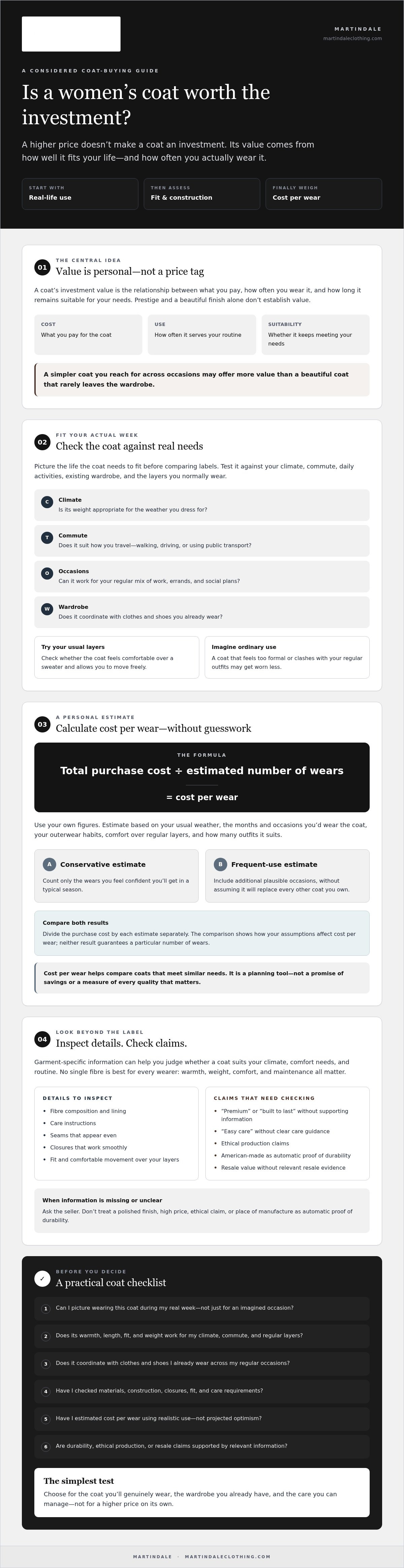
A higher price doesn’t make a coat an investment; a place in your life does. So, is a women’s coat worth the investment? It depends less on prestige than on whether you’ll wear it often, whether it works with your wardrobe, and whether its construction and care requirements suit your routine.
It’s reasonable to ask whether premium materials and careful craftsmanship will translate into useful longevity. A coat that looks beautiful but rarely leaves the wardrobe may offer less value than a simpler piece you reach for across occasions and seasons. Cost per wear can help you think it through, but it’s a personal estimate, not a promise of savings.
This guide offers a practical framework for weighing likely wear, versatility, construction, and provenance. You’ll learn what to inspect, how to estimate cost per wear for your own routine, and how to consider claims about ethical production and American-made garments without treating them as automatic proof of durability. The goal is a considered choice, not a higher price for its own sake.
When Is a Women's Coat Worth the Investment? Start With Your Real Needs
A coat earns investment value through use, not price or prestige alone. Before comparing labels, picture the life it needs to fit: your climate, commute, daily activities, and the clothes already in your wardrobe. A polished coat that feels too formal, clashes with your usual outfits, or is uncomfortable over your regular layers may be a poor choice for you, even if it’s beautifully made.
What does investment value mean for a coat?
Investment value is the relationship between what you pay, how often you actually wear a coat, and how long it remains suitable for your needs. A coat’s value comes from the balance of its cost, its quality, and the frequency with which it serves you. Durability and resale value are separate claims. Assess construction and care information for the first, and seek relevant resale evidence for the second. Neither is guaranteed by a high price. For context on the garment’s broader history of the coat, consider how its practical role has endured across changing styles.
Will this coat fit your everyday wardrobe?
Test a specific coat against your actual week, not an imagined occasion. List the outfits and settings it needs to serve. Then consider whether its warmth, length, and fit suit your routine. Try to account for the layers you usually wear underneath: if the coat restricts movement or feels uncomfortable over a sweater, you may be less likely to reach for it.
- Climate: Is its weight appropriate for the weather you dress for?
- Commute: Does it suit how you travel, whether you walk, drive, or use public transport?
- Occasions: Can it work for your regular mix of work, errands, and social plans?
- Wardrobe: Does it coordinate with clothes and shoes you already wear?
Your sense of lasting style is personal, while construction details and care instructions are things you can check. Consider both before deciding.
How to Calculate a Women's Coat's Cost Per Wear Without Guesswork
Cost per wear makes a coat’s value easier to compare, as long as the estimate reflects your habits rather than an idealised future. The formula is simple: total purchase cost ÷ estimated number of wears = cost per wear. Use your own figures, and treat the result as a planning tool, not a prediction. A women's coat worth the investment for one person may not be worth it for someone with a different climate or routine.
How should you estimate wears honestly?
Start with the months and occasions when you’d realistically wear the coat. Think about your usual weather, how often you reach for outerwear, whether the coat feels comfortable over your regular layers, and how many outfits it suits. Then make two estimates:
- Conservative: Count only the wears you feel confident you’ll get in a typical season.
- Frequent-use: Include additional plausible occasions, but don’t assume the coat will replace every other one you own.
Divide the purchase cost by each estimate separately. Comparing the results shows how your assumptions affect cost per wear. Neither calculation guarantees a particular number of wears.
What can cost per wear tell you, and what can’t it?
Use the calculation to compare the cost of each use across coats that meet similar needs. It can’t measure ethical production, craftsmanship, fit, comfort, or environmental impact. Consider those separately, looking for information about materials, construction, provenance, and care where available. For broader context on investment choices, see The Definitive Guide to Investing in Women’s Coats.
Cost per wear depends on actual use, not projected optimism. Revisit your estimate if your routine or wardrobe changes. Once you’ve identified the kind of coat you’ll reach for, explore women’s coats and assess each option against the same realistic assumptions.
Which Coat Qualities Support Long-Term Value, and Which Claims Need Proof?
A refined appearance can attract you to a coat, but it can’t confirm how it’s made or cared for. Read the garment-specific information: fibre composition, lining, seams, closures, fit guidance, and care instructions. These details help you judge whether it suits your climate, comfort needs, and routine. No single fibre is best for every wearer; warmth, weight, comfort, and maintenance all matter.
What should you inspect before choosing a coat?
Look for clear specifications, then consider how the coat feels and functions. Check that seams appear even and closures work smoothly. Try the fit with the kinds of layers you expect to wear, and notice whether you can move comfortably. Read the care guidance before buying, especially if it differs from what you can manage. If a detail is missing or unclear, ask the seller rather than treating a polished finish as proof.
Does ethical or American-made production prove durability?
No. Production origin and ethical practices matter, but they don’t by themselves establish how a garment performs or how long it will suit your needs. Check what a sourcing or manufacturing statement covers, then assess construction and care separately. Martindale says its garments are designed and sewn in America and describes its production as ethical. Consider that information alongside the details of the individual coat. For further production context, consult American Made Women’s Outerwear: A Guide to Ethical Luxury and Craft.
To compare available options against these details, explore women’s coats. A women’s coat worth the investment should align with both your standards and your real use.
A Practical 2026 Checklist for Choosing a Women's Investment Coat
A considered choice begins with your own standards, not a ranking or a silhouette that happens to be prominent this season. Use these questions to compare coats consistently. If important answers are missing, pause and seek clearer information before deciding.
A five-question decision checklist
- Does it suit your climate? Consider the weather you actually dress for and whether the coat’s weight and coverage seem appropriate.
- Will it work with your wardrobe? Picture it with clothes and shoes you already wear, not outfits you’d need to build around it.
- Does the fit support your routine? Check comfort, ease of movement, and room for the layers you commonly wear.
- Can it serve regular occasions? Consider whether you’d reach for it on commutes, errands, at work, or for social plans.
- Are the details clear, and does the choice still make sense? Review materials, construction, care instructions, and production claims. Then estimate wears conservatively. If the coat still feels worthwhile, your decision rests on a more grounded basis.
Keep your answers beside you as you compare options. A coat doesn’t need to satisfy every possible use; it needs to serve your real ones. This approach also helps separate personal style, which is yours to judge, from garment details and provenance, which should be described clearly.
Explore considered outerwear options
Martindale’s outerwear is designed and sewn in America, and the brand describes its production as ethical. These are factors to assess alongside fit, materials, construction, care, and expected use, not guarantees of durability. Its confirmed outerwear categories include wool coats and trench coats. If they align with your checklist, take a considered look through the women's coat collection. The right women's coat worth the investment is the one that suits your life and standards, not simply the season’s prevailing mood.
Choose a Coat You’ll Wear With Confidence
A women's coat worth the investment isn’t defined by price alone. It’s one that fits your climate and wardrobe, feels comfortable in your routine, and comes with clear material, construction, and care details. Estimate wear conservatively, then weigh that practical value alongside production information you can verify. No single claim, including origin or ethical commitments, tells the whole story.
Martindale’s garments are designed and sewn in America, and the brand emphasizes ethical production. Its outerwear includes wool coats and trench coats. Consider these details as part of your decision, alongside how well a coat suits your life, rather than as a promise of a particular lifespan.
Take your time, use the criteria that matter to you, and choose with care. Explore Martindale’s considered women’s outerwear as you compare your options. The right choice is one you’ll be glad to reach for, season after season.
Frequently Asked Questions
Is an expensive women's coat always worth the investment?
No. A higher price doesn’t guarantee that a coat will suit your routine, offer useful longevity, or work with your wardrobe. Consider how often you expect to wear it, whether its fit and materials meet your needs, and whether construction and care information are clear. A less expensive coat that serves you comfortably and often may be a better choice for your circumstances.
How do you calculate a coat's cost per wear?
Divide the coat’s total purchase cost by your estimated number of wears. Build that estimate around your climate, occasions, wardrobe habits, and how comfortable the coat feels in regular use. You can compare a conservative estimate with a more frequent-use scenario, but neither predicts what will happen. Cost per wear compares use; it doesn’t measure craftsmanship, ethical production, fit, or environmental impact.
What should I look for in a women's coat before buying?
Check the fibre composition, lining, seams, closures, fit information, and care instructions. Consider whether the coat suits your climate and allows comfortable movement with the layers you usually wear. Look for specific details rather than relying on broad words such as “premium” or “long-lasting.” If a material, construction, or production claim isn’t clear, ask the seller what it means for that garment.
Can a classic coat stay stylish for years?
It can, especially if its silhouette and colour feel right to you and work with clothes you already wear. But “classic” doesn’t guarantee lasting personal appeal. Choose based on your own style, occasions, and wardrobe rather than a trend forecast or someone else’s shortlist. A coat you enjoy wearing is more likely to remain part of your rotation than one chosen only for its reputation.
Does American-made production mean a coat will last longer?
No. Manufacturing origin alone doesn’t prove durability or predict how long a coat will remain suitable. Treat origin and ethical production as important considerations, then assess the garment’s materials, construction details, care guidance, fit, and likely use separately. Martindale garments are designed and sewn in America, and the brand emphasizes ethical production. Those details offer production context, not a guarantee of lifespan.


