


What if the wool content is only the first chapter of a coat’s price story? It’s fair to ask why are wool coats so expensive when two labels can both say “wool” yet reveal little about how a coat is made or finished. A premium price deserves more than a polished description. You should be able to assess the details behind it.
This guide explains how fiber composition, fabric and lining, construction, labor, and production choices can shape a wool coat’s cost. You’ll learn what to compare, which details are useful, and how to weigh them against your climate, wardrobe, and expected wear. Martindale’s Patrice and Eleanor provide concrete examples: both specify their wool blends and cupro linings, while the Eleanor also has a silk lapel. The goal isn’t to treat every expensive coat as a sound investment. It’s to help you decide whether a particular coat suits your needs and is worth its price to you.
Why Are Wool Coats So Expensive? Start with What You’re Paying For
A wool coat’s price can reflect its fiber, construction, labor, and design. But a higher price alone doesn’t prove that a coat is better made. To understand why are wool coats so expensive, look beyond the number on the tag. Check what the product description specifies, how the garment is assembled, and whether its fit and design suit the way you’ll wear it.
Wool-coat value is the relationship between a garment’s materials and making, its price, and the use and enjoyment it offers its wearer. It’s personal, not a promise of how long a coat will last.
Why identical wool labels can lead to different prices
A fiber label tells you the fabric’s composition, but not its full character or how carefully the coat is made. Wool has varied origins and properties, as outlined in this overview of the properties of wool. Compare the label with details about the lining, fit, finishing, and manufacturing. For example, Martindale’s Patrice is made from 90% Australian wool and 10% polyamide, with a 100% cupro lining and genuine horn buttons. The Eleanor is made from 90% wool and 10% polyamide, with a 100% cupro lining and a 100% silk lapel. Those specifics give you more to compare than a wool percentage alone.
What a premium price does, and does not, tell you
A price may reflect skilled labor, production choices, and design, but broad phrases such as “luxury” don’t explain those elements on their own. Martindale’s wool coats are Made in America and Ethically Made. These details describe how they’re produced, but don’t automatically prove quality or longevity. Look for information you can assess, then weigh it against your own needs.
- Construction: Check whether the lining, buttons, pockets, vents, and other finishing details are clearly described.
- Suitability: Consider comfort, fit, climate, and the layers you expect to wear underneath.
- Use: A coat you reach for often may feel more worthwhile than one that rarely leaves the wardrobe.
How Wool Coat Materials and Construction Shape the Price
To understand why are wool coats so expensive, look at the whole garment, not just the wool percentage. The blend, lining, closures, pockets, vents, finishing, and manufacturing all contribute to what goes into a coat. A higher proportion of wool isn’t automatic proof of better quality. The fiber label describes composition, not the care or complexity of the construction.
Read the fiber label alongside the garment details
Martindale’s Patrice is made from 90% Australian wool and 10% polyamide; the Eleanor is made from 90% wool and 10% polyamide, with no Australian origin stated. Both have 100% cupro linings. The lining is a separate material inside the coat, while the Eleanor’s 100% silk lapel adds another material to its design. These details help you compare garments precisely, but don’t establish overall quality by themselves.
A fiber-content label identifies what a coat is made from; it doesn’t describe the full construction that brings the garment together.
Construction details that take material and labor
Look beyond the shell fabric. The Patrice has genuine horn buttons, on-seam side pockets, and a back vent. The Eleanor has horn buttons, welt pockets, and a back vent. Each feature involves choices about materials, placement, and finishing. A tailored or slim silhouette also involves decisions about how the garment is shaped. Those details can add work and cost, but their presence alone doesn’t guarantee a particular result or lifespan.
Manufacturing location and ethical production are separate parts of the price story. Martindale’s coats are Made in America and Ethically Made. These commitments describe production context, not automatic proof of quality. To compare American-made women’s outerwear, consider each coat’s materials and design details alongside its fit and price.
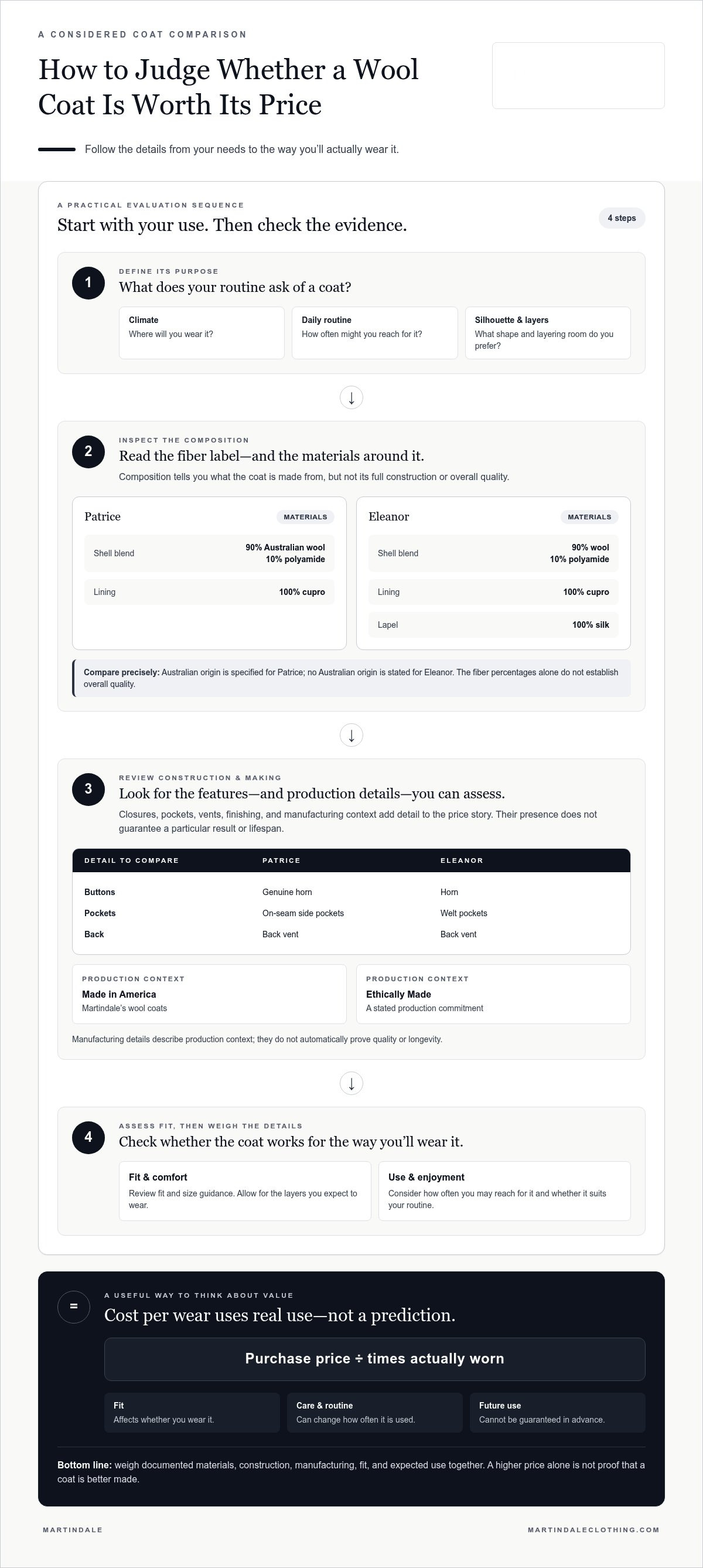
How to Judge Whether a Wool Coat Is Worth Its Price
The question why are wool coats so expensive is useful, but the better buying question is whether a coat’s materials and design suit your life. Use this sequence to compare options thoughtfully:
- Define its purpose. Consider your climate, daily routine, preferred silhouette, and how much room you need for layers.
- Inspect the composition. Read the fiber percentages and note the materials used for the lining and other details.
- Review the construction. Look for clear information about finishing, closures, pockets, vents, and where the coat is made.
- Assess the fit. Check the fit description and size guidance. A coat should feel comfortable with the layers you expect to wear, not just look appealing on a product page.
A practical checklist before comparing coats
Compare like with like. A structured silhouette may suit different occasions than a relaxed one, and your warmth needs depend on where and how you’ll wear the coat. Then weigh documented details together rather than treating price or wool percentage as a verdict. Fiber, lining, finishing, and manufacturing information can help explain differences; whether those differences matter depends on your priorities. For a useful comparison, note each coat’s blend, lining, closures, pockets, fit, and price in one place.
Use cost per wear without pretending to predict the future
Cost per wear = purchase price ÷ the number of times you actually wear the coat. The result changes with real use, not an imagined estimate. Fit, care, changing routines, and whether you reach for the coat again are personal variables; none can guarantee a particular lifespan or value. The same considered approach applies to a professional women’s wool coat: its worth depends on how well it serves the wearer’s needs.
For a practical comparison of materials and design, explore Martindale’s women’s outerwear collection and consider which details suit your routine.
What a Considered Wool Coat Looks Like at Martindale
Specific product details make a coat’s price easier to evaluate, though no single example proves that every premium garment is worthwhile. Martindale’s Patrice and Eleanor show how fiber composition, lining, and design features can be stated clearly. Both are Made in America and Ethically Made. These facts describe their production and materials, leaving you to decide whether the details justify the price for your needs.
Compare the Patrice and Eleanor by their stated details
- The Patrice Wool Coat: 90% Australian wool and 10% polyamide, with a 100% cupro lining, genuine horn buttons, on-seam side pockets, a back vent, and a shawl collar. It has a tailored fit. The price is $1,395.
- The Eleanor Wool Tuxedo Coat: 90% wool and 10% polyamide, with a 100% cupro lining, a 100% silk lapel, horn buttons, welt pockets, and a back vent. It has a slim fit. The price is $1,195.
The distinction matters: Australian wool is specified for the Patrice, not the Eleanor. The two coats share a wool-and-polyamide blend and cupro lining, while their listed design and finishing details differ. Compare those specifics with your priorities, rather than assuming one coat is superior based on its fiber percentage or a single feature.
A considered next step
Fit is part of the assessment, too. The Patrice has a tailored fit, and the size guidance is to choose one size up from your usual. The Eleanor has a slim fit, with the same guidance to choose one size up. Consider that alongside the materials, construction, and occasions you expect to wear the coat. This kind of close comparison brings a more useful answer to why are wool coats so expensive than price alone can offer.
Explore Martindale’s women’s wool coat collection to compare each coat’s stated details with your needs and intended use.
Make Your Next Coat Choice With Confidence
The question of why are wool coats so expensive is best answered by details you can evaluate, not a price tag treated as proof. Let the information guide your decision, then consider whether the coat’s design, fit, and intended use make sense for your wardrobe. A thoughtful purchase isn’t about choosing the most expensive option; it’s about choosing with clarity.
Martindale’s Patrice and Eleanor offer a useful example of clearly stated product information. Each has a specified wool blend and lining; the Patrice includes genuine horn buttons and the Eleanor a 100% silk lapel. Both are Made in America and Ethically Made. The Patrice is $1,395, and the Eleanor is $1,195. Compare these details with your priorities to decide how well each coat fits your needs.
Explore the collection, compare the details, and choose the coat that suits the way you dress and live. Explore Martindale’s outerwear.
Frequently Asked Questions
Why are wool coats more expensive than other coats?
Wool coats may cost more because their price can reflect wool and other materials, garment construction, finishing, skilled labor, and manufacturing choices. The answer to why are wool coats so expensive varies from coat to coat, and a premium price alone doesn’t establish quality or value. Compare the stated specifications and fit with what you need, such as room for layers or details suited to your usual routine.
Does 100% wool mean a coat is better quality?
No. A 100% wool label describes fiber composition, not the complete garment. It doesn’t tell you about the lining, how seams and finishing are handled, or whether the shape suits you. Compare the coat’s interior and visible details as well as its label. Neither a blend nor a pure-wool composition proves quality on its own; judge the whole coat against your intended use.
How can I tell if a wool coat is worth its price?
Compare the fiber composition, lining, construction details, fit, and manufacturing information with your priorities. Then consider cost per wear: divide the purchase price by the number of times you actually wear the coat. This is a way to reflect on use, not a promise of savings. Your habits, fit preferences, and care affect the outcome, so avoid treating an estimate as a guaranteed result.
Are wool coats made in America always more expensive?
No. A coat’s manufacturing location can be one element of its price, but it doesn’t establish that every American-made wool coat costs more or offers better value. Consider the stated origin alongside materials, construction, and other production information. A label can clarify where a garment was made; it can’t tell you by itself whether its design, fit, and use align with your expectations.


