


With the global price of wool rising by over 51 percent in the year leading to August 2026, a coat is no longer a simple seasonal purchase; it's a significant financial commitment. Most women have felt the frustration of a heavy garment that looks substantial but leaves them shivering, or a fabric that begins to pill before the first snow falls. You've likely realized that a high price tag doesn't always guarantee lasting value or moral integrity in an industry often built on the temporary.
Learning how to identify a high quality women's coat is the essential skill that separates a legacy-grade garment from disposable fast fashion. This guide provides the precise knowledge you need to evaluate material composition, construction techniques, and the latest ethical standards. We'll explore the distinction between synthetic blends and superior English wool, the significance of PFAS-free certifications, and the specific structural markers found in American-made pieces like the Patrice Wool Coat. You'll gain the confidence to choose an investment that offers superior warmth without bulk and remains a staple in your wardrobe for decades.
The Foundation of Longevity: Fiber Content and Material Integrity
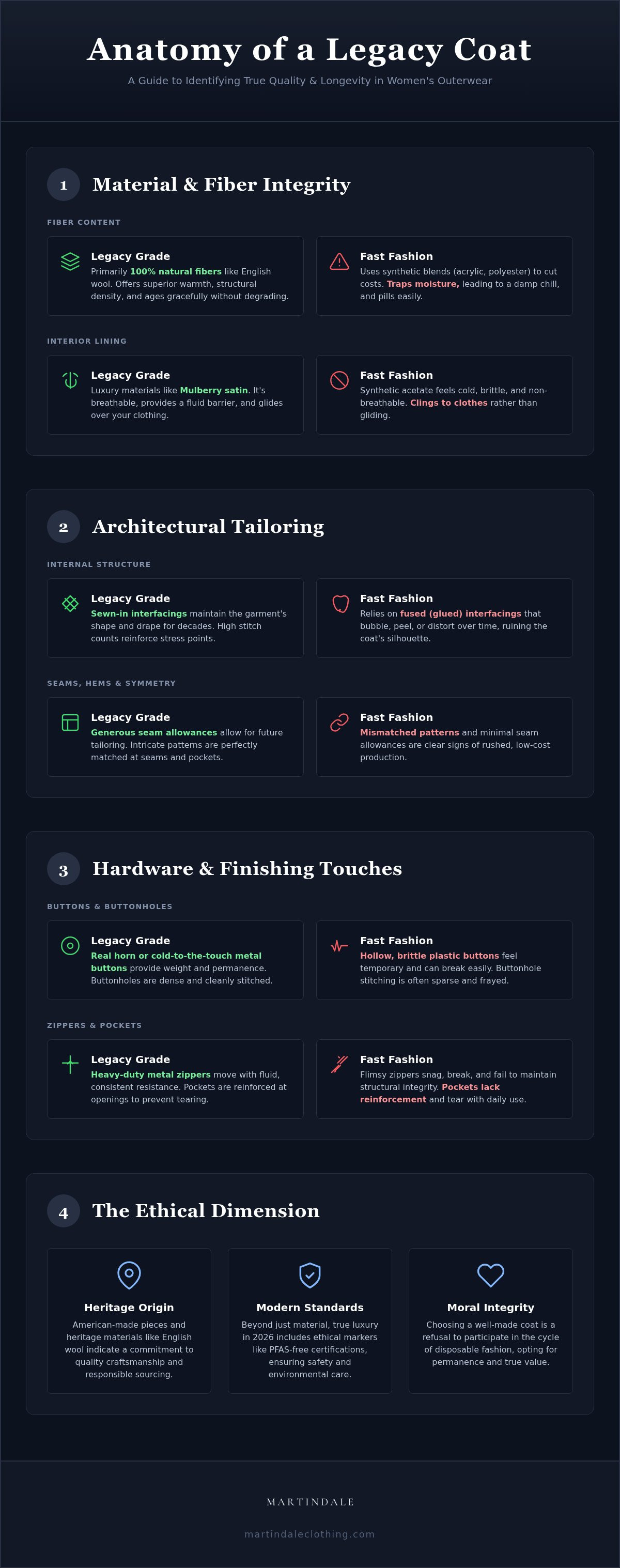
The soul of a garment lives in its fibers. To understand how to identify a high quality women's coat, you must look beyond the silhouette to the material integrity. High-quality fabric isn't just an aesthetic choice; it's the primary determinant of how a piece regulates heat and resists the elements over decades. While mass-market retailers often suggest a 70 percent wool blend is sufficient, true investment pieces rely on 100 percent natural fibers. English wool offers a structural density that synthetic alternatives cannot replicate.
You can feel the difference immediately. A premium piece, such as the Patrice Wool Coat, has a distinct weight and a spring-back resilience when squeezed. It lacks the initial oily fuzziness common in cheaper blends. Even the interior matters. While synthetic acetate feels cold and brittle, luxury Mulberry satin provides a breathable, fluid barrier that respects the skin. This interior layer ensures the coat glides over your clothing rather than clinging to it.
The Truth About Synthetic Blends in 2026
Acrylic and polyester are frequently used to mimic the density of natural wool at a lower cost, yet they sacrifice durability. These materials trap moisture against the body, leading to a damp chill rather than dry warmth. Pilling is the physical result of short synthetic fibers breaking and tangling under friction. Once these fibers begin to knot, the garment's structural integrity is permanently compromised.
Why Material Origin Matters
Heritage materials like English wool possess a natural lanolin and tight weave that provide superior winter insulation. These are slow materials that age with grace, softening and conforming to your form rather than degrading. Investing in a piece like the Maggie Glen Plaid Trench ensures you are wearing a story of permanence. It's a refusal to participate in the cycle of disposable fashion, opting instead for a garment that remains steadfast through years of wear.
Architectural Tailoring: Identifying Superior Construction and Stitching
While industry novices often claim weight equates to value, true excellence lies in the internal architecture. A coat's drape is its most honest feature. It should follow the body's lines gracefully without pulling or distorting, a quality found in timeless silhouettes like the Eleanor Wool Coat. Fast fashion often relies on fused interfacings, where stiffening fabric is glued to the outer shell. Over time, these layers bubble or peel. High-quality pieces use sewn-in structures that maintain the garment's shape for decades. When considering how to identify a high quality women's coat, look for high stitch counts and reinforced stress areas like armholes and pockets. Dense, even stitching ensures seams don't gap or fray under daily pressure.
The Hidden Details: Linings and Seam Allowances
Generous seam allowances, the extra fabric tucked inside the garment, are a hallmark of legacy-grade outerwear. They allow for future tailoring or repairs, acknowledging that a body may change over twenty years. Premium coats often feature hand-finished hems rather than simple bagged linings. A bagged lining is quickly sewn and turned inside out, often leaving the coat feeling hollow. This structural scrutiny is part of how to identify a high quality women's coat that will survive beyond a single winter.
Pattern Matching and Symmetry
Symmetry is the ultimate test of a maker's patience and moral integrity. In a piece like the Maggie Glen Plaid Trench, the intricate lines of the English wool must align perfectly at the side seams and pockets. Rushed production ignores these details to maximize fabric yield. A mismatched pattern is a loud admission of low-quality manufacturing, indicating a garment designed for a single season rather than a lifetime.
The Quality Checklist: Hardware, Weight, and Finishing Touches
The final markers of excellence aren't found in a logo, but in the weight of a button and the precision of a buttonhole. When you seek to understand how to identify a high quality women's coat, look for hardware that offers weight and permanence. Real horn or cold-to-the-touch metal buttons provide the necessary ballast for a garment's drape, whereas hollow plastic feels brittle and temporary. The 'hand' of the fabric is equally revealing. It should feel substantial and dense, yet never stiff. High-quality wool possesses a natural elasticity that resists permanent creasing. Examine the buttonholes for dense, clean stitching. If you see frayed edges, it's a sign of a machine-timed process that prioritizes speed over the long-term relationship you deserve with your clothing.
Evaluating Zippers and Closures
Heavy-duty metal zippers are essential for maintaining the structural integrity of styles like the Amelia Bomber Jacket. Perform a 'snag test' by pulling the slider slowly; it should move with a fluid, consistent resistance rather than catching. Luxury hardware is designed to outlast the fabric itself. It ensures the closure remains as reliable in a decade as it is today. Pockets should also be functional and reinforced at the openings with bar-tacks to prevent tearing from daily use.
The Importance of the 'Spare Button' Test
A premium brand's commitment to the future is often hidden in a small envelope. Including high-quality spare buttons is a silent promise that the garment is meant to be maintained, not replaced. This philosophy is central to why choosing domestic craftsmanship is vital for your professional wardrobe. You can learn more about this in our guide on The Professional Women's Wool Coat: Why Made in USA is the Ultimate Career Investment for 2026. Invest in a garment that honors these standards by browsing our collection of ethically made outerwear.
The Ethical Dimension: Why Origin and Craftsmanship Define True Luxury
True luxury is a moral choice. In an industry often defined by transience, choosing a garment with a transparent origin is a revolutionary act. Quality is inseparable from the ethics of its creation. When you consider how to identify a high quality women's coat, the ethical origin serves as the final seal of authenticity. It's a rejection of the temporary in favor of the permanent, ensuring your garment carries a legacy of responsibility.
The Value of 'Made in the USA'
Domestic production is the antidote to the opacity of global fast fashion. By designing and sewing garments in America, we maintain a level of quality control that mass-market brands can't replicate. This proximity allows for intentional, smaller batches where every stitch is scrutinized. The durability of the Patrice Wool Coat is a direct result of skilled artisans who preserve traditional methods. These craftsmen earn fair wages, ensuring the beauty of your garment isn't built on the hardship of others.
Calculating Cost Per Wear
A legacy-grade coat is a deliberate financial strategy. While a synthetic blend costs less today, its inevitable degradation makes it an expensive mistake. A premium wool coat is designed to last decades. If a garment serves you for twenty years, the daily cost becomes negligible. This shift from consumption to stewardship is the heart of the slow fashion movement. It's a commitment to buying fewer, better objects that age with dignity.
Choosing a Martindale coat is a rejection of the temporary nature of modern retail. It's an investment in domestic skill and material permanence. Learning how to identify a high quality women's coat means recognizing that the story behind the piece is as vital as the wool itself. You can discover the Martindale collection of ethically made American outerwear and begin your partnership with a piece built for a lifetime.
Investing in a Legacy: Your Path to Permanent Style
Choosing a garment that survives the shifting winds of industry trends requires more than an eye for aesthetics; it demands an understanding of structural and moral integrity. You now possess the specialized knowledge of how to identify a high quality women's coat by scrutinizing fiber density, internal tailoring, and the weight of luxury hardware. True value is found when 100 percent natural materials like English wool meet the precision of domestic craftsmanship. These are the markers of a piece designed for decades of wear rather than a single season of utility.
By prioritizing ethical American production and timeless silhouettes, you reject the cycle of disposable fashion in favor of a lasting partnership. Every Martindale piece is designed and sewn in the USA to ensure these rigorous standards are met without compromise. It's time to elevate your wardrobe with a garment that honors your discernment and provides superior warmth for years to come. Shop the Martindale Collection of Timeless, American-Made Coats and embrace the enduring beauty of a well-considered investment.
Frequently Asked Questions
How can you tell if a coat is high quality just by looking at it?
Visual quality is signaled by the intentional alignment of patterns at the seams and the way the fabric hangs without ripples. A high-quality coat will possess a natural luster and a dense weave that suggests weight without bulk. Look at the edges; they should be crisp and uniform. These visual cues are essential when learning how to identify a high quality women's coat at a glance, reflecting a maker's commitment to precision.
Is 100% wool always better than a wool blend for winter coats?
Pure natural fibers are superior because they offer thermal regulation and breathability that synthetic blends cannot match. While acrylic or polyester are often added to reduce costs, they trap moisture and lead to pilling. A 100 percent wool coat remains a permanent staple because it ages gracefully. Understanding how to identify a high quality women's coat involves recognizing that natural fibers are a long-term investment in comfort and durability.
What are the signs of poor quality stitching in women's outerwear?
Poor quality is evidenced by low stitch counts, uneven spacing, or visible loose threads at the ends of seams. High-quality garments feature small, tight stitches that provide structural stability. If a seam gaps when gently pulled or if the thread color doesn't perfectly match the fabric, the piece was likely mass-produced with little regard for longevity. Exceptional outerwear requires reinforced stitching in high-stress areas like the armholes and pocket corners.
Why are American-made coats often more expensive than imported ones?
The cost reflects a commitment to ethical labor practices and superior quality control. American-made garments are produced in smaller, intentional batches by skilled artisans who earn fair wages. This domestic focus eliminates the environmental and moral costs associated with long-distance supply chains. When you invest in a coat designed and sewn in the USA, you're paying for transparency, craftsmanship, and the preservation of domestic skills that prioritize substance over profit.
How do I check the quality of a coat's lining before buying?
A superior lining should feel fluid and substantial, like Mulberry satin, rather than thin or brittle. Check if the lining is 'bagged' or hand-finished at the hem; a loose, floating hem often indicates higher quality construction that allows the coat to move with your body. Ensure there's a pleat at the center back to provide ease of movement. A well-chosen lining protects the outer wool and ensures a comfortable, long-term partnership.


