

A polished label and an immaculate product photograph can make a coat seem like a lasting investment. Neither shows how it will wear. If you’re wondering how to tell if a coat is high quality, look beyond the brand name. The fabric, seams, lining, hardware, fit, and information about where and how it was made offer more useful evidence.
It’s reasonable to feel uncertain when a product page makes broad claims but shows little about construction. A coat can look refined and still have weak seams, an uncomfortable fit, or materials that don’t suit its intended use. This guide explains what to check before buying, from fabric composition and stitching to fit, finishing, and sourcing. You’ll learn how to compare coats, what questions to ask, and how to choose a piece that suits your needs and long-term wear.
How to Tell If a Coat Is High Quality: Start With the Whole Garment
A coat’s quality isn’t established by its price, a familiar label, or a polished photograph. Those may shape expectations, but they don’t show whether the fabric suits the weather, the seams are carefully finished, or the fit allows comfortable movement. Judge the whole garment against how you plan to wear it and how much care you can give it.
What does high quality mean in a coat?
Appearance is only one part of the assessment. Substantial fabric can still disappoint if the seams, lining, or closures are poorly finished. A carefully made coat may also be a poor match if it’s too light for your intended use or requires care you can’t maintain. The history and types of coats offer useful context, but quality is best judged against the garment’s purpose.
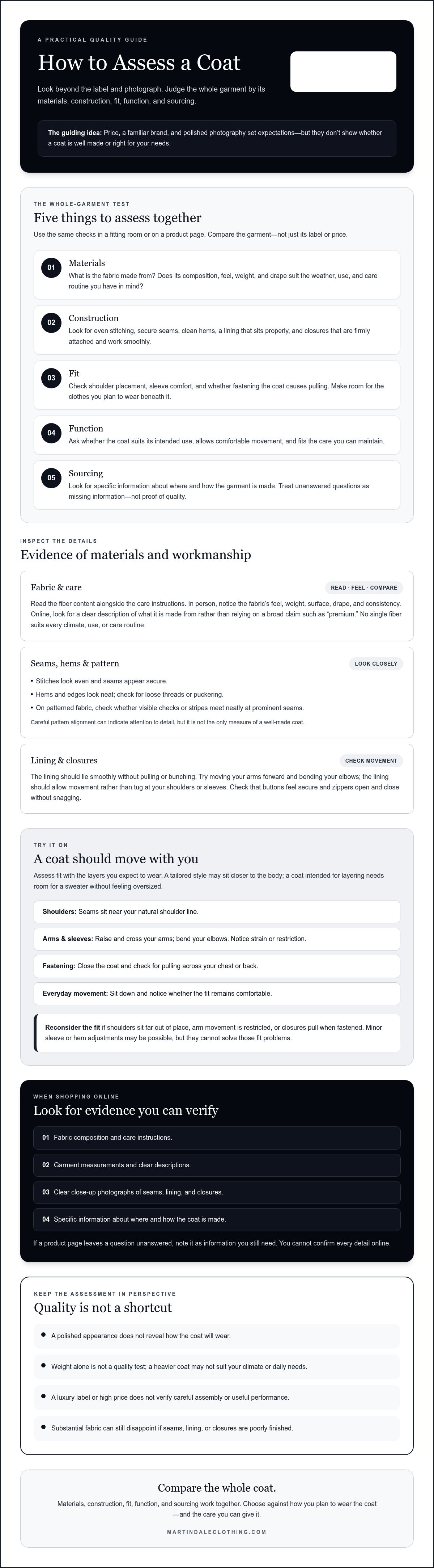
A practical five-part test: assess a coat’s materials, construction, fit, function, and sourcing together rather than relying on its label alone.
Which details should you assess first?
Use the same checks in a fitting room or on a product page. Read the fabric composition and care instructions, inspect the seams, lining, and closures, and consider how the coat fits over the clothes you’ll wear beneath it. Look for specific production information, too. Compare these details across coats, not just brand names or prices. If a product page leaves a question unanswered, treat that as missing information, not proof of quality.
- Materials: What is the fabric made from, and does it suit the intended use?
- Construction: Do the seams and finishes appear neat and consistent?
- Fit and function: Can you move comfortably, and does the design meet your needs?
- Sourcing: Does the brand explain where and how the garment is made?
For example, Martindale states that its garments are designed and sewn in America and describes its production as ethical. That information can help you assess sourcing, while the coat’s materials, construction, and fit still need to be considered individually.
Check the Fabric, Lining, Seams, and Closures for Evidence of Craft
To understand how to tell if a coat is high quality, look past the silhouette and examine its materials and finishing. Read the fiber content alongside the care instructions. Wool, cotton, synthetic fibers, and blends have different qualities, and no single fiber suits every climate, use, or care routine. In person, feel the fabric and notice its weight, surface, drape, and consistency. Online, look for a clear description of what the coat is made from rather than relying on broad terms such as “premium.”
How can you assess the fabric and lining?
Check whether the lining lies smoothly and is attached neatly, without pulling or bunching. If you can try on the coat, move your arms forward and bend your elbows. The lining should allow movement rather than tug at your shoulders or sleeves. Online, look for clear close-up images and descriptions. If the lining material or care requirements aren’t stated, note that as a question to ask.
Which construction details reveal careful workmanship?
Look for observable signs of finishing: even stitching, secure seams, clean hems, firmly attached buttons, smooth-running zippers, and a lining that sits properly. If the fabric has a pattern, check how it meets at prominent seams. Careful alignment can indicate attention to detail, though it isn’t the only measure of a well-made coat.
- Fabric: Does the listed composition suit the warmth, weather, and care you need? Check its feel, weight, and drape.
- Seams and hems: Are the stitches even, the edges neat, and the seams secure? Look for loose threads or puckering.
- Lining: Does it lie flat and allow comfortable sleeve movement? Check for pulling or bunching.
- Closures: Do the buttons feel secure, and do zippers open and close without snagging?
- Pattern matching: Do visible checks or stripes meet neatly at prominent seams?
Apply the same checks to each coat you compare. For another reference point, browse Martindale’s women’s coats and outerwear, then review the fabric and care details listed for each garment.
Assess Fit and Finish: Question Common Quality Shortcuts
A coat should work with your posture and the layers you plan to wear, not simply look right on a hanger. Check that the shoulder seams sit near your natural shoulder line, the sleeves reach comfortably, and fastening the coat doesn’t pull across your chest or back. Raise and cross your arms, bend your elbows, and sit down. Notice any strain or restriction.
How should a well-fitting coat move?
Fit depends on the coat’s intended silhouette and how you’ll use it. A tailored style may sit closer to the body, while a coat for layering needs room for a sweater without feeling oversized. Minor sleeve or hem adjustments may be possible, but alterations can’t solve shoulders that sit far out of place, restricted arm movement, or closures that pull when fastened. Consider those signs a reason to reconsider the fit.
Weight alone isn’t a quality test. A heavier coat may not suit your climate or daily needs, and a luxury label or high price doesn’t verify careful assembly or useful performance. To judge whether a coat is high quality, consider how it fits and functions alongside the specific evidence on its product page.
Can you judge quality from a product page?
You can’t confirm every detail online, but you can look for information that supports a considered choice. Seek garment measurements, clear photographs of seams and closures, fabric composition, care guidance, sourcing details, and return terms. Words such as “exceptional” or “premium” are claims, not proof. If important details are missing, ask before buying or compare the coat with a listing that provides them.
- Measurements: Compare the stated dimensions with a coat you already find comfortable.
- Photos: Look for close views of the shoulders, sleeves, closures, and inside finish.
- Practical terms: Review the care instructions and return conditions before ordering.
Use these checks to compare garments, not just labels. Explore Martindale’s women’s coats and outerwear and review the listed details as you assess fit and finish.
Compare Coat Quality and Choose With Confidence
Start with your needs, not a label. Decide where and how often you’ll wear the coat, then check its materials, construction, fit, function, care requirements, and sourcing. Weigh the trade-offs against your climate and habits. A coat suited to frequent cold-weather wear may not be right for a milder climate or a care routine that calls for easy maintenance.
How do you compare two coats side by side?
Use a simple scorecard for each coat. Mark each area “clear,” “needs checking,” or “unknown,” and write down unanswered questions instead of filling gaps with assumptions.
- Fabric: Does the stated composition suit your warmth and weather needs?
- Construction: Do the visible finishes appear neat and secure?
- Fit and function: Can you move comfortably, and does the design work for your routine?
- Care: Are the instructions manageable for you?
- Sourcing: Does the brand provide specific information about where and how the coat is made?
Prioritize the factors that matter most to you. A coat with transparent sourcing but a poor fit may not be the right choice. An appealing fabric may also involve care you don’t want to take on. American-made or ethical production can be meaningful sourcing considerations, but neither alone proves that a particular garment has strong construction or suits your needs. Look for clear claims, then assess the coat itself.
Where can you explore considered women’s outerwear?
Martindale states that its garments are designed and sewn in America and describes its production as ethical. Those details offer a starting point for assessing sourcing. Check the fabric composition, care guidance, and other garment-specific information on each product page. Explore the women’s coat collection and apply the same scorecard to each option. A deliberate comparison helps you choose for your needs, not just for a coat’s first impression.
Choose a Coat With Confidence
Knowing how to tell if a coat is high quality means looking beyond its label or first impression. Consider the fabric and care requirements, inspect the construction, and make sure the fit supports the way you’ll wear it. Then weigh those details against your climate, routine, and priorities. Clear sourcing information can strengthen your assessment, but it doesn’t replace checking the garment itself.
Martindale offers a point of reference: its garments are designed and sewn in the United States, and the brand describes its production as ethical, with a focus on long-term wear. Review each coat individually, then decide whether its materials, fit, and care needs suit you.
Take your time and choose with intention. Explore Martindale’s women’s outerwear and find a coat that suits your wardrobe and the wear you expect from it.
Frequently Asked Questions
How can you tell if a coat is well made?
Assess the whole coat rather than relying on its label or appearance. Check the fabric composition and care instructions, then look for even stitching, secure seams, a smoothly attached lining, and closures that work without catching. Try it on and move your arms to test comfort. Clear information about where and how it was made can also help you evaluate sourcing.
Does a more expensive coat mean it is higher quality?
No. A higher price may reflect factors such as materials, design, or brand positioning, but it doesn’t prove that a coat is well constructed or suitable for your needs. Compare the fiber content, visible finishing, fit, care requirements, and sourcing information. A coat’s value depends on how well those details align with your intended use, not price alone.
What should I look for in a coat’s seams and lining?
Look for stitching that appears even and secure, with no obvious loose threads, puckering, or gaps along seams and hems. Check that buttons are firmly attached and the lining lies smoothly without pulling or bunching. If trying on the coat, move your arms forward and bend your elbows. The lining should allow comfortable movement rather than tugging at the sleeves or shoulders.
Can you tell if a coat is high quality when shopping online?
You can make an informed assessment, though photographs can’t confirm every detail. To judge how to tell if a coat is high quality online, look for specific fabric composition, care guidance, garment measurements, close-up images of seams and closures, and clear sourcing information. Treat broad claims such as “premium” as statements to verify. Note unanswered questions and review return terms before ordering.
How should a quality coat fit?
A coat should suit its intended silhouette and leave enough room for the layers you plan to wear. Check that the shoulders sit comfortably, the sleeves reach appropriately, and fastening the coat doesn’t pull across your chest or back. Raise and cross your arms, then sit down. You should be able to move naturally without excess tightness or fabric that overwhelms your frame.


