


A garment’s ethical claims are only as credible as the accountability behind them. Understanding what ethically made clothing means starts with looking beyond the finished piece to the people and practices involved in making it. Accountability, integrity, and reliable evidence help show whether a brand’s commitments are reflected in production. Audits can provide a structured way to assess those practices.
A thoughtful label or appealing story can be a starting point, but it isn’t the same as clear responsibility. Learn how accountability differs from a promise, what integrity and reliability look like in clothing production, and how audit standards can help assess a brand’s claims without treating an audit as proof of everything. Together, these ideas offer a more grounded way to understand a garment’s story and make choices based on more than appearance.
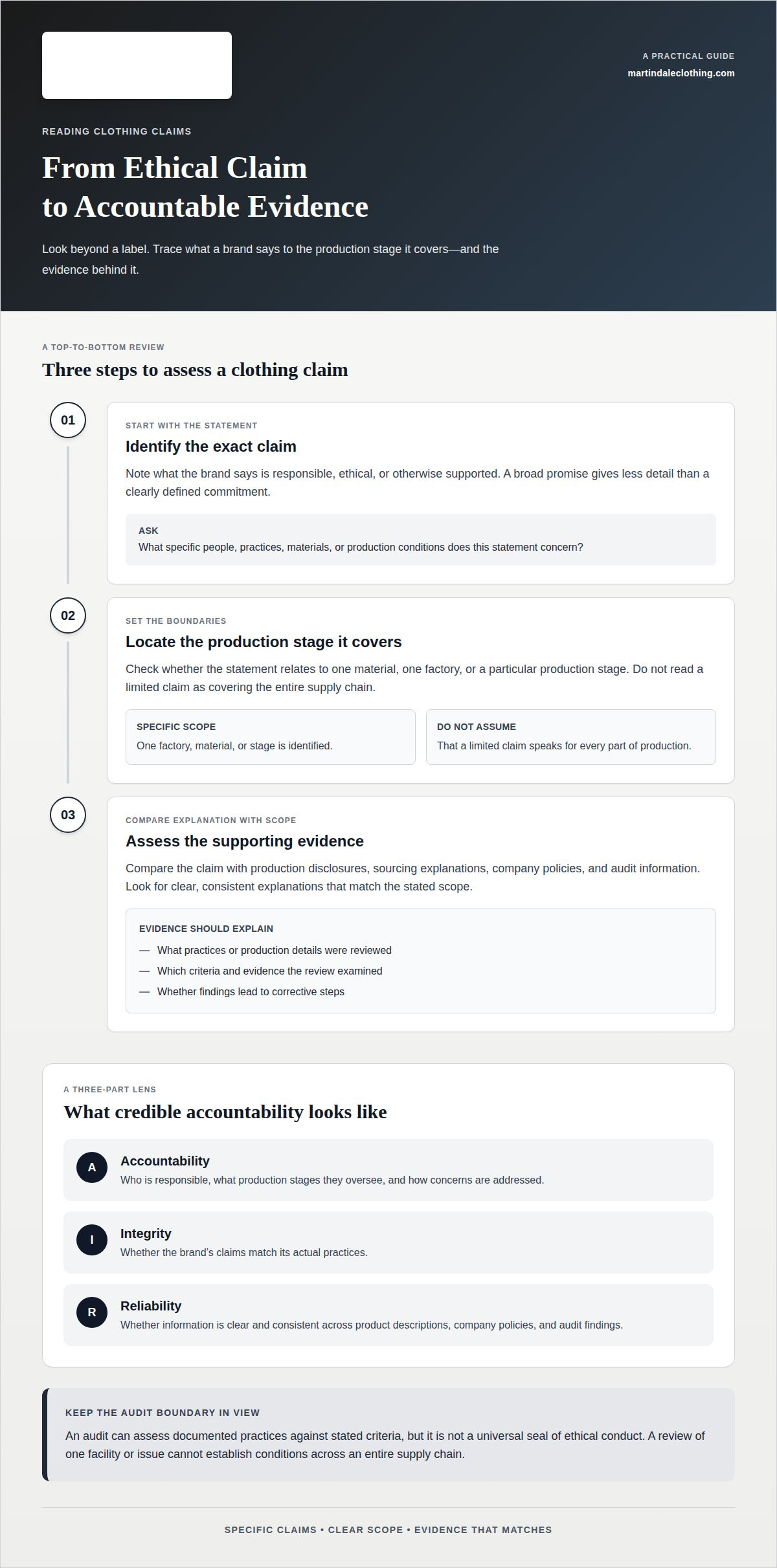
A single garment can support all three aims, but the labels alone don’t establish that. Consider each claim on its own terms: what issue it addresses, which production stage it covers, and what supporting explanation accompanies it. This makes ethical clothing claims easier to interpret without mistaking one meaningful practice for a complete account.
How much does ethically made clothing typically cost compared with fast fashion?
There isn’t one reliable price difference between ethically made clothing and fast fashion. A cotton T-shirt, wool coat, and satin jacket use different materials, construction, and labor. Their prices can’t be compared meaningfully as if they were the same garment. Ethical production may involve higher labor or material costs, but the final price also reflects design, production scale, and retail decisions.
Consider two coats with similar silhouettes. One may use carefully sourced wool and skilled construction, while another may be designed for a short trend cycle. Fiber quality, fabric weight, lining, finishing, and assembly all affect cost. Production volume matters too: making fewer pieces can spread design and setup expenses across fewer garments. None of these factors alone proves a coat was made ethically.
Rather than focusing only on the ticket price, consider how long a piece is likely to serve its purpose. A useful comparison is purchase price divided by expected wears. A coat worn across many seasons may offer better value per wear than a lower-priced coat replaced quickly. This calculation doesn’t measure working conditions or environmental impact, so it complements rather than replaces those considerations.
To compare similar garments, use a consistent sequence:
- Match the category: compare coat with coat, not a T-shirt with outerwear.
- Review construction: look at fabric, lining, seams, closures, and finishing.
- Consider use: estimate how often the garment suits your wardrobe and climate.
- Read the production claim: distinguish information about workers or sourcing from general ethical language.
Fast fashion’s lower upfront price can be appealing, while a thoughtfully made garment may require a larger initial investment. But price alone is not a verdict. A high price doesn’t guarantee responsible production, and a lower price doesn’t explain the conditions behind a garment. Compare the specific item, its construction, intended lifespan, and the evidence supporting its ethical claims. That puts cost in context without confusing expense with accountability.
What are common risks of greenwashing in ethical fashion?
Greenwashing occurs when a clothing claim creates a more responsible impression than its evidence supports. A label reading “conscious” may sound meaningful, but it doesn’t explain a garment’s materials, workers, or production stages. For example, a recycled-fiber detail on a jacket says nothing by itself about sewing conditions. Broad language can conceal a narrow improvement.
Scope is a frequent problem. A brand might describe one factory as responsible while saying little about other facilities or suppliers. A claim about organic cotton may concern the fiber, not dyeing, assembly, or transport. Read each statement for its subject and boundaries. If the wording implies one positive attribute covers the entire garment, the impression may go beyond the evidence provided.
Another risk is treating a certification or audit as a universal guarantee. A logo may refer to a particular material, facility, or standard, rather than every product and production step. Likewise, an audit that examines one issue cannot establish performance on unrelated issues. Look for the program’s scope, the process assessed, and whether findings led to changes.
- Vague labels: “Eco-friendly” or “ethical” without a defined practice gives little information about a cotton shirt or wool coat.
- Selective disclosure: Highlighting recycled packaging while omitting garment production shifts attention from the product’s main impacts.
- Unclear certification: A badge without its name, criteria, or covered stages makes its meaning difficult to assess.
- Unsubstantiated absolutes: Words such as “always” or “zero impact” imply broad proof that a single initiative cannot establish.
Use a simple reading test: identify the exact claim, the product or stage it covers, and the supporting explanation. Then compare them. If a campaign features a “responsibly made” coat but explains only its fabric, the labor claim remains unaddressed. That gap doesn’t prove misconduct, but it shows what the statement actually establishes.
Specificity protects the meaning of ethical fashion. A clear claim names its subject and limits; evocative imagery or polished language cannot substitute for those details. This distinction helps readers recognize progress without mistaking a partial effort for a complete account of a garment’s production.
Martindale
Martindale offers a considered next step for readers seeking clothing made with responsibility and longevity in mind. Its garments are ethically produced and designed and sewn in America, with a focus on enduring pieces rather than fleeting trends. That commitment gives the ideas in this guide a practical context: accountability concerns how production choices are made, while integrity calls for those choices to align with a brand’s claims.
The collection includes women’s coats and wool coats, alongside The Amelia Bomber Jacket in Mulberry Satin and The Amelia Bomber Jacket in Midnight Satin. These pieces let you explore considered design through garments intended for lasting use, not fast-fashion cycles.
If you’d like to learn more about Martindale’s approach to clothing, contact Martindale.
Let your next choice reflect what matters
Knowing what ethically made clothing means can give your next purchase a more deliberate starting point. Consider the role a garment will fill, how often you expect to wear it, and whether its design will suit your wardrobe beyond a passing trend. A clear personal standard can make decisions easier: choose the qualities you value, then let those priorities guide what earns a place in your closet.
Notice which silhouettes, fabrics, and colors you return to, then favor pieces that work across settings already part of your life. That pause gives each purchase a purpose. The aim isn’t perfection in every decision. It’s a more thoughtful relationship with clothing, shaped by attention rather than urgency.
To continue exploring considered clothing with Martindale, contact Martindale to learn more. Let your next choice reflect your values and bring quiet confidence to your wardrobe.
Frequently Asked Questions
What does ethically made clothing mean?
Ethically made clothing means garments are produced with attention to the people and practices involved in making them. Understanding what ethically made clothing means starts with the garment’s own journey: who made it, where production took place, and how workers’ concerns are handled. For example, a brand’s description of a sewing facility can clarify who is responsible for conditions at that stage.
What labor standards define ethically made clothing?
Labor standards commonly considered include safe workplaces, fair pay, reasonable hours, voluntary employment, and protection from discrimination. They also concern whether workers can raise concerns without retaliation. A practical example is a workplace process for reporting and addressing a safety hazard. These criteria make labor commitments more specific, though a claim about one standard alone doesn’t describe every condition across production.
How can shoppers verify a clothing brand’s ethical claims?
Trace a claim through the brand’s product information and production disclosures. For a cotton garment, note whether the brand identifies the fiber’s source, the place of assembly, and the stages covered by supporting documents. Look for a named standard or facility, the assessment’s scope, and any follow-up described after findings. If details conflict across pages, treat the discrepancy as a question about clarity, not proof of wrongdoing.
What certifications indicate ethically made clothing in the United States?
No single certification establishes every ethical attribute of a garment. Certifications may assess a defined issue, such as fiber sourcing, chemical management, or workplace conditions. Read the certificate’s name, criteria, and covered product or production stage; a material-focused certification, for example, doesn’t by itself establish workers’ conditions. The key is to understand what was assessed and what remains outside the certification’s scope.


